


Soft Starter Knowledge: Working Principles, Ratings and Applications
Understand how a motor soft starter works, where it is used, and how current, torque, starting duty and bypass arrangements influence selection.

What Is a Motor Soft Starter?
A motor soft starter is an electronic device that controls the voltage applied to an AC motor during starting. Its purpose is to manage the transition from standstill to normal running speed, reducing the abrupt electrical and mechanical effects associated with an uncontrolled start. Where the selected model supports it, a controlled stopping function can also help manage the shutdown of the driven process.
Soft starters are commonly used with three-phase induction motors driving pumps, fans, compressors, conveyors and other industrial machines. The starter must allow the motor to develop enough torque to accelerate the actual load. A gentle start is useful only when the machine reaches its required running condition within the permitted thermal duty.
The complete installation includes more than the starter itself. Supply protection, isolation, the motor, the driven equipment, control circuits and any bypass arrangement must work together. Selecting a motor soft starter therefore starts with the application, not just the motor’s kW rating.
How Does a Soft Starter Work?
Many industrial soft starters use antiparallel thyristors, also called silicon-controlled rectifiers or SCRs, in the power circuit. By adjusting when these devices conduct during each AC cycle, the controller changes the effective voltage delivered to the motor. The exact power-circuit arrangement depends on the product.
At the beginning of a start, the controller applies an initial voltage or follows a defined current-control strategy. It then increases the available voltage as the motor accelerates. The objective is to develop sufficient accelerating torque without imposing an unnecessarily severe current demand or mechanical shock.
Reducing voltage also reduces the torque available from the motor. As a useful approximation at a given operating condition, induction-motor torque varies with the square of applied voltage. For example, reducing voltage to 80% gives approximately 64% of the corresponding torque. This is an explanatory relationship, not a universal starter setting: the motor’s torque-speed curve and the machine’s load torque still determine whether acceleration is possible.
Voltage Ramp, Current Limit and Starting Torque
A voltage ramp increases applied voltage over a configured period. Initial voltage must be high enough to start the load moving, while the ramp must suit the machine’s acceleration requirements. A programmed ramp time is not a guarantee that the motor will reach full speed in that exact time.
Current limiting controls the electrical demand during starting. A lower current setting may reduce disturbance on the supply, but it also limits available motor torque. If the motor stalls or accelerates too slowly, simply extending the ramp can increase heating.
The required starting torque depends on the process. An unloaded compressor and a loaded conveyor can impose very different demands on motors of the same rated power. Static friction, material already in the machine, pump conditions and fan inertia all affect the starting calculation.
Record the actual starting current and acceleration time during commissioning using appropriate procedures. These observations help confirm that the chosen configuration matches the intended duty.
Soft Starter Voltage, Current and Power Ratings
The starter’s main-circuit voltage must match the motor supply. Industrial installations may use voltage classes such as 220–240 V, 380–415 V, 440–480 V or 600–690 V. These are general industry examples; the permitted range must be checked for the exact starter. Medium-voltage motors require dedicated equipment and system design.
Control power is a separate specification. A starter suitable for a particular main supply does not necessarily use that same voltage for its control terminals. Confirm both ratings before preparing the cabinet drawings.
| Rating or requirement | Why it matters | Information to provide |
|---|---|---|
| Motor rated current | Determines the continuous-current requirement | Motor nameplate and connection |
| Main supply voltage | Defines power-circuit compatibility | Nominal voltage and expected variation |
| Starting current | Influences torque and semiconductor heating | Required current limit and measured or calculated duty |
| Starting duration | Long acceleration increases thermal demand | Expected time to reach operating speed |
| Start repetition | Heat may accumulate between starts | Starts per hour and minimum rest time |
| Ambient conditions | Can require derating or different ventilation | Temperature, altitude and enclosure arrangement |
A motor-power table is a selection aid, not a substitute for checking current and starting duty. The same kW motor can require a different starter size when the voltage, load or start frequency changes.
Where Are Soft Starters Used?
| Application | Purpose | Main selection question |
|---|---|---|
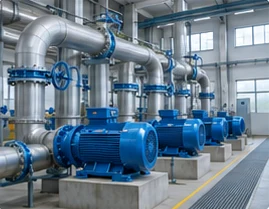
| Water-supply pumps | Manage motor acceleration and hydraulic transitions | What are the system pressure, valve behaviour and stopping requirements? |
| Wastewater pumps | Start pumping equipment under defined process conditions | Can the pump start with the expected solids and load? |
| Ventilation and process fans | Accelerate a rotating load without abrupt mechanical stress | How much inertia must be accelerated, and how long will it take? |
| Air compressors | Control starting demand | Does the compressor start unloaded or against pressure? |
| Conveyors | Reduce sudden torque changes at startup | Is material present, and what breakaway torque is needed? |
| Crushers and mixers | Manage demanding industrial starts where suitable | Can the motor accelerate the worst-case load within the permitted duty? |
Application names alone do not establish suitability. A pump can have a straightforward start or a difficult hydraulic condition. A fan can require a long acceleration because of high inertia. A loaded crusher may need substantial starting torque and a larger starter, or a different starting arrangement determined by the engineering review.
Built-In Bypass and Online Operation
During SCR conduction, the semiconductor devices dissipate heat. In a bypass arrangement, a contactor carries the motor current after the starting sequence is complete. This reduces running losses in the semiconductor path and can simplify thermal management.
A built-in bypass soft starter incorporates the bypass contactor into the product. An online configuration may keep the semiconductor path involved during operation, depending on its design. An external bypass is a separate arrangement that must be explicitly supported by the starter and approved wiring.
Do not assume that external bypass wiring is permitted simply because another starter supports it. INOMAX AST7000 uses its built-in bypass arrangement; its installation must follow the supplied model documentation. Protection coverage during bypass must also be confirmed from the actual product design, rather than inferred from the contactor’s presence.
Soft Stop and Water Hammer in Pumping Systems
A soft-stop function changes the electrical transition as a pump motor stops. In suitable applications, this can help reduce abrupt changes in flow. However, the hydraulic outcome also depends on pipe length, elevation, operating pressure, non-return valves and the pump curve.
Soft stop does not guarantee that water hammer disappears. A pipeline can require additional hydraulic measures, and a longer stopping time is not automatically better. The system designer should determine the required stopping behaviour and confirm it during controlled testing.
A voltage ramp-down is also not the same as an active braking system. A high-inertia fan may continue to coast after motor torque is removed. When a machine requires a precisely controlled stopping time, that requirement must be stated before selecting the starter and associated equipment.
Starting Duty, Heavy Loads and Thermal Management
Starting duty is a combination of current, time and repetition. A starter that handles an occasional start may not handle frequent starts at the same current and duration. Repeated attempts after an unsuccessful start can make both motor and starter temperatures rise before an operator recognizes the problem.
Heavy-load selection should consider the full torque-speed relationship. The motor must produce more torque than the load requires throughout acceleration. If the margin becomes too small, the motor can remain at a low speed while drawing high current.
Cabinet design also matters. Confirm the ambient temperature at the starter’s air inlet, not only the outdoor weather report. Nearby equipment, enclosure size, blocked filters and inadequate spacing can increase internal temperature. Apply the exact manufacturer’s derating rules and keep ventilation paths accessible for maintenance.
For a replacement project, collect historical trip records and starting measurements. A larger starter may provide more thermal capacity, but it does not correct a jammed machine, an unsuitable motor or incorrect electrical connections.
Protection, Monitoring and Communications
Depending on the model, a soft starter can monitor conditions such as motor overload, phase problems, starting timeout and equipment temperature. The availability, detection method and setting range of each function must be checked in the product manual.
Starter protection does not remove the need for correctly coordinated short-circuit protection, isolation and earthing. Protective devices and contactors must be selected for the supply and installation, with the applicable coordination requirements addressed by the cabinet designer.
Communication allows an automation system to request operation and collect status or fault information. Confirm the protocol, required registers, update rate and behaviour following a communication loss. A network command is an operating interface; it should not be assumed to provide a certified machine-safety function.
Temperature-sensor inputs and additional networks may require option hardware. Specify these requirements in the enquiry so that the supplied starter and cabinet include the correct interfaces.
How to Select an INOMAX Soft Starter
Begin with the motor rated voltage and current, then describe the load in enough detail to evaluate acceleration. Provide starting current restrictions, expected start time, starts per hour and the minimum rest interval. Include the worst operating condition, such as restarting a loaded conveyor after an interruption.
Next, define the cabinet environment, bypass arrangement, control-power supply, communications and protection requirements. If certificates or specific test reports are mandatory, identify them before finalizing the technical proposal.
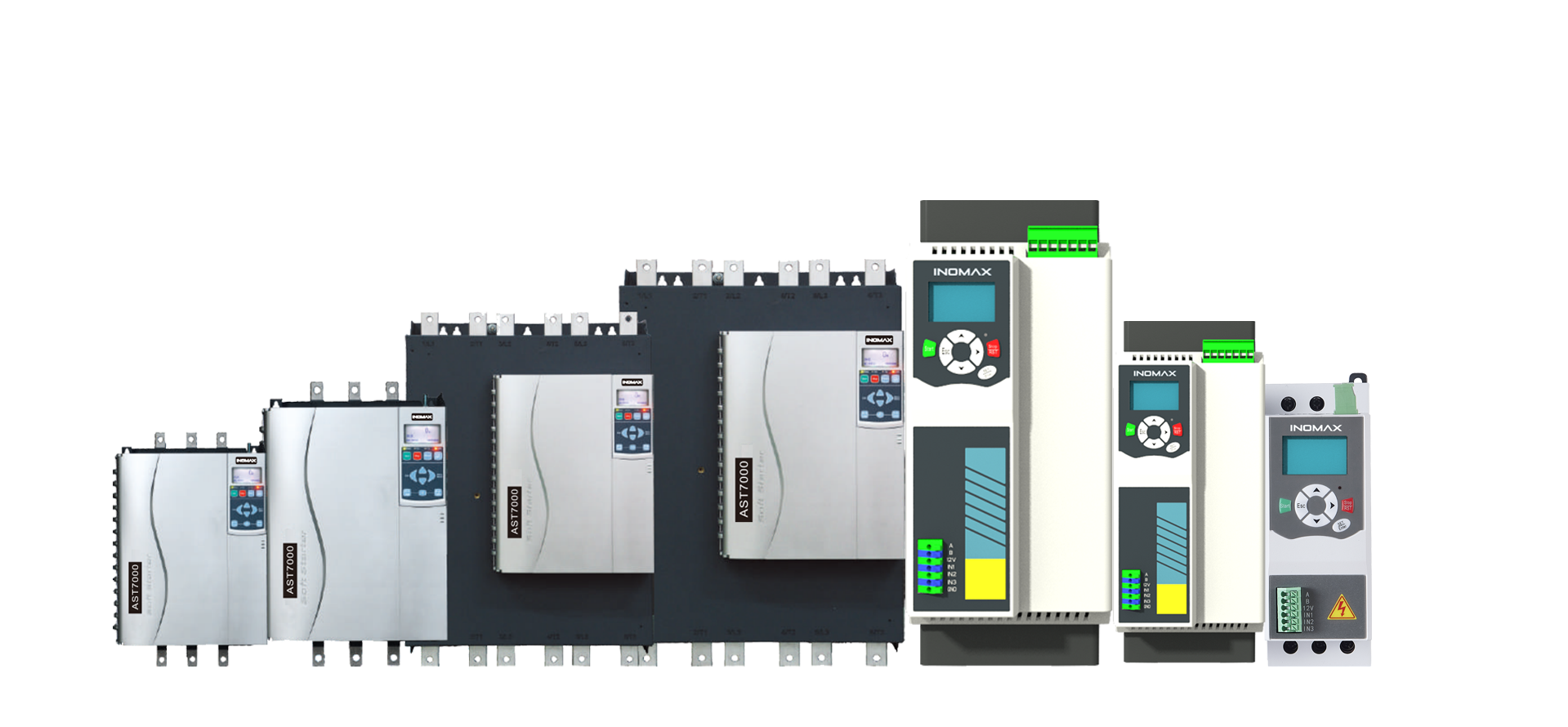
INOMAX AST soft starter families address different low-voltage starting requirements. For AST7000, the built-in bypass and application-duty requirements should be reviewed together. Medium-voltage applications require a dedicated MAX-MVSS review covering the motor, supply, protection and cabinet configuration.
Use the detailed soft starter selection guide for pumps, fans and heavy loads. Send nameplates, load information and drawings to info@inomaxtechnology.com for model-specific evaluation.
Frequently Asked Questions About Soft Starters
Does a soft starter eliminate starting current?
No. The motor still needs current to produce starting torque. The objective is to manage the start within the motor, supply and machine requirements.
Can I select only by motor kW?
No. Check rated current, voltage, starting current, acceleration time, repetition and derating.
Why does a motor fail to accelerate with a low current limit?
The available torque may be insufficient for the load. Review the mechanical condition and approved settings rather than repeatedly attempting the same start.
Does built-in bypass mean no ventilation is required?
No. Starting losses and other internal heat sources remain. Follow the product’s installation clearances and cabinet cooling requirements.
Can soft stop guarantee a fixed stopping time?
No. Stopping depends on the load and available stopping function. State any controlled-stop requirement during system design.
Can every soft starter use an external bypass?
No. Bypass compatibility is model-specific. Use the manufacturer’s permitted circuit; do not add an unsupported arrangement.
What should I record after a fault?
Record the model, motor nameplate, fault code, stage of operation, recent starts and load condition. Preserve the evidence before changing settings.
Can I reuse settings from another installation?
Only after checking the motor, load and product configuration. Similar motor power does not mean identical starting requirements.