


Liquid-cooled power stage
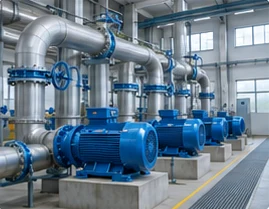
Main rectifier and inverter modules use liquid cooling, with fan cooling for filters and auxiliaries.

MARINE & OFFSHORE · MEXICO
Propulsion & tunnel thrusters · AFE cabinet engineering · Shorter supply proposal
An urgent replacement of failed liquid-cooled drives, developed around the vessel’s existing motors, control interfaces and installation requirements.
01 / PROJECT OVERVIEW
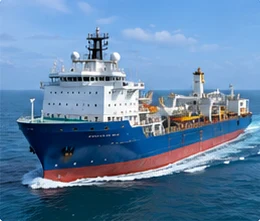
A multipurpose diving support vessel in Mexico needed a new liquid-cooled drive solution after its original equipment failed.
The original supplier’s quoted lead time was approximately 30 weeks. With replacement equipment needed urgently, the customer evaluated INOMAX’s 4–6-week supply proposal alongside the technical requirements of the existing installation.
The project documents cover Veth propulsion and tunnel-thruster systems, Wölfer AC motors and an Ingeteam INGEDRIVE LV400 platform. INOMAX developed an ACS880 liquid-cooled AFE cabinet solution around these existing equipment and interface requirements.
THE CUSTOMER’S TIME CONSTRAINT
Quoted supply times for this project. The comparison does not represent measured vessel downtime.
02 / PROJECT REQUIREMENTS
03 / INOMAX SOLUTION
Power conversion, cooling and control are coordinated within a multi-section cabinet arrangement.
Main rectifier and inverter modules use liquid cooling, with fan cooling for filters and auxiliaries.
An AFE rectifier and motor-side inverter form the proposed power-conversion architecture.
Speed reference, feedback and status signals are reviewed against the vessel’s original control requirements.
Control, incoming power, filtering, conversion and cooling sections are arranged for each motor application.
Selected cabinet design views. Customer title blocks and project identifiers are excluded. Dimensions are W × D × H; the released configuration governs each order.
→
→
→
The technical instructions describe Local/Remote selection, local Start/Stop, a 10-inch HMI, fault display and parameter monitoring.
Flow and temperature monitoring support alarm or trip responses. Motor thermal inputs must match the installed PTC or PT100 sensors.
04 / TECHNICAL DATA
Selected ratings from the original nameplates and the INOMAX engineering package. Customer serial numbers and vessel identifiers are withheld.
| Parameter | Tunnel-thruster motor | Propulsion motor |
|---|---|---|
| Rated power | 900 kW | 1,500 kW |
| Voltage / frequency | 0–480 V Δ / 0–60 Hz | 0–480 V Δ / 0–60 Hz |
| Nameplate speed | 0–892 rpm | 0–1,790 rpm |
| Nameplate current | 490–1,345 A | 490–2,000 A |
| Duty / protection | S1 / IP54 | S1 / IP54 |
| Thermal sensors | 6 × PTC | 6 × PT100 |
| Parameter | Original Ingeteam nameplate |
|---|---|
| Product | INGEDRIVE LV400 |
| Converter rated power | 1,600 kW |
| Input | 480 V AC / 2,555 A |
| Output | 0–480 V AC / 2,834 A |
| Output frequency | 0–120 Hz |
| Topology / cooling | AFE / fresh water |
The 1,600 kW converter rating and the 1,500 kW motor rating describe different pieces of equipment.
| Engineering item | 900 kW motor application | 1,500 kW motor application |
|---|---|---|
| Cabinet drawing designation | 1,000 kW cabinet | 1,500 kW cabinet |
| AFE / rectifier model | ACS880-2L87-1760A-3 +PALM+PCU+MYC |
ACS880-3L87-2610A-3 +PALM+PCU+MYC |
| Motor-side inverter model | ACS880-2L87-1760A-3 +PSMM+PCU+MYC |
ACS880-3L87-2610A-3 +PSMM+PCU+MYC |
| Input filter | AIM-LC8-2210A | AIM-LC8×2-2610A |
| Supply shown in design | 3-phase 480 V; single-phase 220 V auxiliary | 3-phase 480 V; single-phase 220 V auxiliary |
| Enclosure design requirement | IP44 | IP44 |
Model selections shown here are from the selected cabinet drawings. Final equipment ratings, marine documentation and interface details follow the agreed project scope.
05 / WHY INOMAX
The commercial opportunity came from delivery time. The engineering response addressed the installed motor and vessel interfaces.
4–6 weeks compared with approximately 30 weeks from the original supplier, according to the project account.
The evaluation used motor plates, original drive data, control drawings and the vessel installation context.
Power conversion, cooling supervision, local control and vessel interfaces were considered together.
06 / PROJECT RECORDS
Real project photographs show the manufactured cabinets and packing stage.
This case covers the supplied design, manufacture and dispatch records. Commissioning and sea-trial results are outside the published record.
FOR YOUR NEXT PROJECT
For shipowners, fleet technical teams, repair yards and marine electrical integrators evaluating an alternative marine VFD supplier.
An unavailable spare or a long original-supplier lead time can put a repair schedule at risk. Start with the existing drive, motor and vessel-class requirements.
Assess whether motors, propulsion equipment, cabling and controls can remain in service. Define the electrical and mechanical changes before committing to a replacement.
Align cabinet manufacture, approval activities, shipment, installation and commissioning responsibilities with the vessel’s maintenance window.
The Mexico reference connects an actual replacement requirement with cabinet engineering, manufactured equipment and export-packing photographs. Its 480 V design and quoted supply times are project-specific; another vessel requires its own selection.
07 / YOUR APPLICATION QUESTIONS
Brand alternatives, cooling, power ratings, vessel integration and marine approvals.
Start with your application. Use these answers to identify what can carry over, what needs engineering and what to confirm before ordering.
Yes—INOMAX can engineer an alternative drive solution for an ABB marine VFD replacement project. Selection starts with the complete ABB type code, motor current, duty cycle, cooling method and required marine approvals. The review also covers the rectifier or common DC bus, encoder, fieldbus and cabinet interfaces. Similar model names do not establish interchangeable power modules, firmware or terminal connections; the replacement scope is defined before ordering.
A Siemens marine drive replacement can be evaluated with the existing PLC and vessel controls retained where the interfaces are compatible. Provide the Siemens drive model, motor data, I/O list, fieldbus details and control sequence. The engineering review identifies parameter changes, signal mapping and any PLC or HMI modifications. A shared communication protocol alone does not establish full functional compatibility.
Yes, replacement enquiries can cover Ingeteam and other legacy marine drive systems. This Mexico case provides an Ingeteam replacement reference with cabinet designs, completed equipment and packing records. For another brand or an obsolete model, send the original technical manual, nameplates and interface drawings. INOMAX assesses the required drive functions and system arrangement, including whether to replace an individual drive or the complete cabinet.
Yes. INOMAX ACS drive configurations include both air-cooled and liquid-cooled options. An air-cooled marine VFD selection considers ambient temperature, ventilation, enclosure protection, space and heat rejected into the electrical room. Converting between air cooling and liquid cooling is also an engineering option, but requires a review of cooling infrastructure, cabinet layout and approvals. The liquid-cooled design shown here does not limit enquiries to liquid-cooled vessels.
Yes. The ACS low-voltage drive range includes 480 V and 690 V configurations. A 690 V propulsion or thruster drive must be selected for the actual bus voltage, supply frequency, motor voltage and current, insulation requirements and fault level. The voltage classes use appropriate equipment selections; they are not interchangeable by changing a setting. This Mexico reference remains a 480 V design.
A 2,000 kW marine drive is within the power range that INOMAX can evaluate using its high-power and multi-module platforms. Enquiries for 800 kW, 1,500 kW, 2,000 kW and other ratings are selected individually. Nameplate kW alone is insufficient: continuous current, overload duration, torque-speed duty, voltage, cooling and marine approval coverage determine the final configuration. A larger requirement receives a new selection rather than a scaled copy of this cabinet.
Often the motor can be retained if its electrical, thermal and mechanical characteristics are compatible with the replacement converter. Review motor type, rated current, speed range, insulation, cable length, temperature sensors and encoder or resolver feedback. Output reactors or dv/dt filtering may be needed for the actual motor and cable arrangement. Retaining the gearbox or thruster also requires confirmation of torque limits and control response; motor reuse is assessed rather than assumed.
The integration scope can be developed around the vessel’s dynamic positioning (DP), power management system (PMS), bridge and local controls. Essential inputs include speed or torque references, feedback, available-power limits, ready/run/fault signals and emergency-stop logic. Redundancy, failure behaviour and communication options must be checked with the system integrator. A compatible VFD does not by itself establish DP-class compliance; the complete control chain needs acceptance testing.
An Active Front End is relevant when the marine drive system requires controlled grid-side conversion, reduced input-current harmonics or regenerative power flow. Selection should consider generator capacity, network impedance, other loads and the vessel’s power-quality limits. During regeneration, the shipboard network must have an acceptable way to use or dissipate the returned energy. AFE selection and any braking provision therefore belong in the overall power-system study, not just the motor-drive calculation.
Potentially, after checking coolant quality, inlet temperature, flow, pressure, materials compatibility and heat-removal capacity. The drive’s internal coolant circuit must match the selected power modules; an existing seawater circuit is not assumed suitable for direct connection. Cabinet access, pipe connections, leak monitoring, condensation control and service isolation also affect the retrofit. Share the cooling diagram and operating conditions so the need for a separate cooling unit or heat exchanger can be assessed.
INOMAX’s ACS880 product information lists CCS certification. Certificate coverage must still be confirmed for the exact drive model, voltage, power rating, cooling arrangement and intended application. For a DNV, ABS, Bureau Veritas (BV), Lloyd’s Register (LR) or CCS-classed vessel, request the relevant current certificate and approval scope from our sales team. The proposal should identify existing approval coverage and any additional project requirements; this case is not evidence that every configuration holds every class approval.
Agree the required document and test package with the shipyard, integrator and vessel’s classification society before manufacture. It may include applicable certificates, single-line diagrams, cabinet drawings, electrical ratings, protection and control descriptions, cooling requirements and a factory acceptance test (FAT) plan. Identify any environmental or EMC evidence, witness testing, product certification and onboard acceptance required for the installation. Type approval and approval of the delivered system are separate matters; the agreed supply scope should address both.
INOMAX can review the required delivery date against the selected hardware, engineering scope, approval process and factory test requirements. In this reference, the quoted INOMAX supply time was 4–6 weeks compared with approximately 30 weeks quoted by the original supplier. That is a project-specific comparison. For a new vessel, confirm drawing approval, manufacturing, shipment and installation milestones separately, and allow time for any class review and onboard acceptance.
Compare the complete retrofit scope: drive ratings and overload, AFE and filters, cabinet and cooling, interface engineering, approvals, testing, spare parts and commissioning support. A lower equipment price may not mean a lower installed cost if essential scope is missing. Send the existing drive and motor data, vessel class, control and cooling requirements, available space and target docking date. INOMAX can then discuss a project-specific proposal and define delivery, support and warranty terms.
CUSTOMER PRIVACY & CONFIDENTIALITY
To respect our customers’ privacy and confidentiality commitments, selected customer identities, original drawings and project-specific information are not published. INOMAX works with customers under confidentiality agreements where applicable.
If you are evaluating a similar application, contact the INOMAX sales team. We welcome technical discussions and can share further relevant information within the limits of our confidentiality obligations.
LET’S DISCUSS YOUR APPLICATION
Send the existing drive brand and model, motor ratings, vessel class and target docking date. We’ll discuss compatibility, approval requirements and the supply scope.
Project-specific drive and power conversion systems