
Acceleration sets the peak-current check
Use the current peak, its duration and the time between accelerations to check the inverter overload curve. The entire cycle also has to fit the module’s thermal rating.

Mining / Mine winder drives
The same winder had to accelerate under load and creep through a daily shaft inspection. INOMAX engineered an air-cooled AFE cabinet around both duties.
Project overview
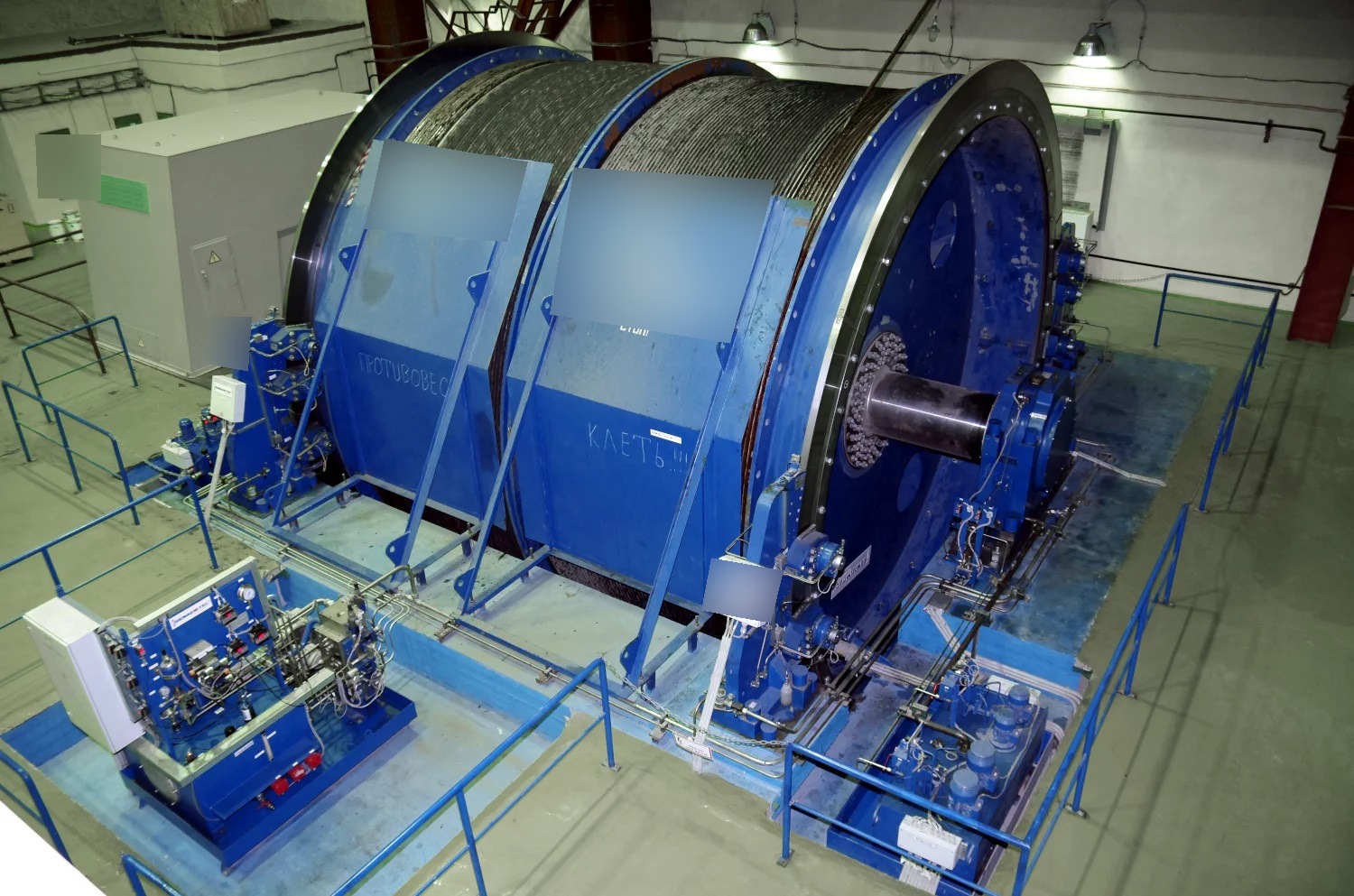
A German customer specified the converter for a mine-hoist project with a Russian end user. The winder operates in automatic, manual and inspection modes. The existing supply transformer had to stay in service.
During inspection, the operator needs sustained, controlled movement at crawl speed. During acceleration, the drive must deliver the current required by the loaded winder. When the load drives the motor, the electrical system also needs a path for the braking energy.
Customer requirements
The specified manual cycle reached the same peak torque as automatic travel. Its RMS torque was higher. Both figures matter when sizing the inverter for repeated acceleration.
| Mode | Speed |p.u.| | RMS torque | Peak |torque| | Static |torque| |
|---|---|---|---|---|
| Automatic | 1.000 | 0.394 | 0.858 | 0.574 |
| Manual | 0.075 | 0.441 | 0.858 | 0.574 |
| Inspection | 0.075 | 0.322 | 0.705 | 0.431 |
Customer’s design load cycles. All torque values are per unit. The speed figures describe the specified cycles; the daily inspection frequency was supplied separately.
Use the current peak, its duration and the time between accelerations to check the inverter overload curve. The entire cycle also has to fit the module’s thermal rating.
INOMAX proposed encoder feedback for 0.06–1.5 Hz operation. The agreement also specifies a 4 kW motor-fan feeder and temperature supervision. A separate requirement covers holding 70% load at zero speed for 30 seconds.
INOMAX solution
The approved design separates the input module, active front end and motor inverter. Each stage has its own current designation and role.
The project calls for a long inspection run at crawl speed. Speed feedback and motor cooling form part of the design for that duty.
The motor-side inverter is selected against peak current, its duration and the repeated cycle. The drawing calls up an SMM rated at 1,160 A.
The ALM connects the DC link to the AC supply so the hoist can return braking energy when the network can absorb it. The specification calls for an LCL filter.
Incoming supply, active rectifier and motor inverter occupy separate bays. The drawings define the power path, ventilation, auxiliaries and PLC interfaces.
| Assembly | INOMAX model | Qty. |
|---|---|---|
| AIM input module | ACS880-R8B-800A-6+AIM | 1 |
| ALM active line module | ACS880-R94-900A-6+ALM+E3PN | 1 |
| SMM motor inverter | ACS880-R95-1160A-6+SMM | 1 |
| Drive operator panel | CP66 | 2 |
Regenerative braking
Manufacturing evidence
The customer confirmed the electrical design. The finished-unit photographs show how INOMAX assembled the incoming switchgear, power modules and operator interfaces. The documented project milestone is cabinet manufacture.
| Site constraint | INOMAX design response | What the project documents show |
|---|---|---|
| Retain the transformer | Use a line-side input module and a separately rated active line module. Review import and braking duty against the available supply. | The agreement specifies the existing 450 kVA transformer. The approved circuit identifies both line-side modules. |
| Run the winder slowly for extended periods | Use shaft feedback and provide for motor cooling throughout inspection. | The agreement calls for feedback, a 4 kW fan feeder and temperature supervision. The drawings show the encoder circuit. |
| Fit the drive into the hoist controls | Integrate the PLC, operator panels and two-channel stop interfaces into one three-bay cabinet. | The electrical package defines the interfaces, and the finished-unit photographs show the three bays and operator stations. |
| Source | Value | Meaning |
|---|---|---|
| Hoist motor | 545 kW at 690 V | Motor annotation on the SMM output drawing (sheet E03/1). |
| Cabinet design | 550 kW | General power on the drawing cover. The input line reads 690 V, 800 A, 50 Hz. |
| Project reference | 1,000 kW | INOMAX project designation. Its relationship to the cabinet plate requires confirmation. |
| Finished cabinet | 1,100 kW / 1,160 A at 690 V | Values on the photographed cabinet label. Use the applicable row for the supply voltage. |
The agreement and approved drawings specify IP20; the plate reads IP21. The specification calls for HTL encoder feedback, while the drawing labels the card EN22B-TTL. Confirm the as-built protection class and feedback interface for any replacement.
Frequently asked questions
Use these questions to compare a retrofit, specify a new drive or prepare a comparable tender.
INOMAX can assess a replacement around the equipment you intend to retain. Send the installed model and drawings, motor and encoder data, braking arrangement and PLC signal list. The comparison should identify which interfaces can be reused, which need modification and how the changeover will be tested.
The answer depends on the torque required at crawl speed, the encoder signal and the motor cooling available for the full inspection period. This project called for 0.06–1.5 Hz for one to two hours daily. Provide the encoder part number, pulse count, supply voltage and the motor fan details so the feedback card and thermal duty can be checked.
Supply a current trace, or torque and speed against time, including the duration and repetition of each acceleration. Compare the peak with the inverter overload envelope and the full cycle with its thermal rating. Here the manual cycle had the same peak torque as automatic travel at just 7.5% of its speed.
A different voltage or motor rating needs its own module selection. Send the supply voltage, motor current, speed range and load cycles. INOMAX can then specify the line side and motor side separately and list the cabinet and cooling requirements for your duty.
It can be assessed if the generator supplier defines the permitted reverse power and the minimum simultaneous site load is known. Use those limits to set the export ceiling. If the hoist must keep braking after that ceiling is reached, provide a separately rated energy path.
A resistor and brake chopper can absorb surplus energy when the network cannot take it. Specify the worst lowering or deceleration event, its duration and how often it repeats. These determine peak resistor power, energy per event and thermal duty. Generator operation and resistor hardware are options for a new enquiry.
INOMAX can include a dedicated DC field drive in the assessment. Supply the motor and field nameplates, field voltage and current, field build-up and de-excitation requirements, plus the existing interlocks. The excitation package is a separate scope item.
The approved design uses an active front end, and the agreement calls for an LCL filter. For a harmonic limit, provide the network data, other major loads and the measurement point. For an energy estimate, provide a representative hoist cycle and the available electrical load during lowering. Define the measurement plan before quoting a numerical target.
The reference design includes PROFINET and two-channel STO and emergency-stop interfaces. Share the PLC signal map, brake feedback and start/stop sequence. The hoist integrator must validate the mechanical holding brake and stopping sequence for the complete machine.
This case concerns an indoor, air-cooled cabinet specified for 0–40 °C below 1,000 m. Send the installation-area classification, dust exposure, room temperature, required enclosure rating and ventilation limits. These determine whether a different enclosure, cooling arrangement or certification scope is needed.
The project specification requests CE and EAC documentation. Identify the required jurisdiction, standards and equipment covered by your tender. Agree which certificates, drawings and factory tests will be provided for the quoted assembly, and which site tests the hoist integrator will witness.
Request an itemised quotation covering power modules, controls, cooling, optional braking or excitation equipment, tests, spares and engineering support. Specify the outage date and who will commission the hoist. Compare suppliers from the same drawing-approval milestone through to delivery and site support.
Engineering enquiries
Send the motor nameplate, a typical lifting and lowering cycle, and the supply arrangement. For a retrofit, include the existing drive model, encoder details and planned shutdown date.
English project case · Updated 6 November 2026. Some customer and technical details are withheld for confidentiality. Further information can be discussed within the permitted disclosure scope.