


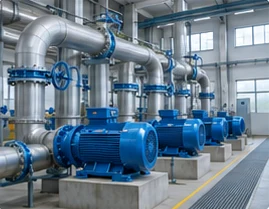


Solar Pump Inverter Knowledge: MPPT, Voltage and Water Pumping Applications
A practical guide to photovoltaic-powered AC water pumping: how the inverter works, how the PV array and motor are matched, and how water demand determines the system.
What Is a Solar Pump Inverter?
A solar pump inverter converts DC electricity from photovoltaic modules into controlled AC power for a compatible water-pump motor. It connects the electrical output of the solar array with the operating requirements of the pump, allowing water delivery to follow the available solar energy within the limits of the system.
The equipment may also be described as an MPPT solar pump drive, solar pumping inverter or photovoltaic pump controller. These names do not establish compatibility by themselves. The motor type, voltage, phase configuration and input arrangement must be checked for the exact product.
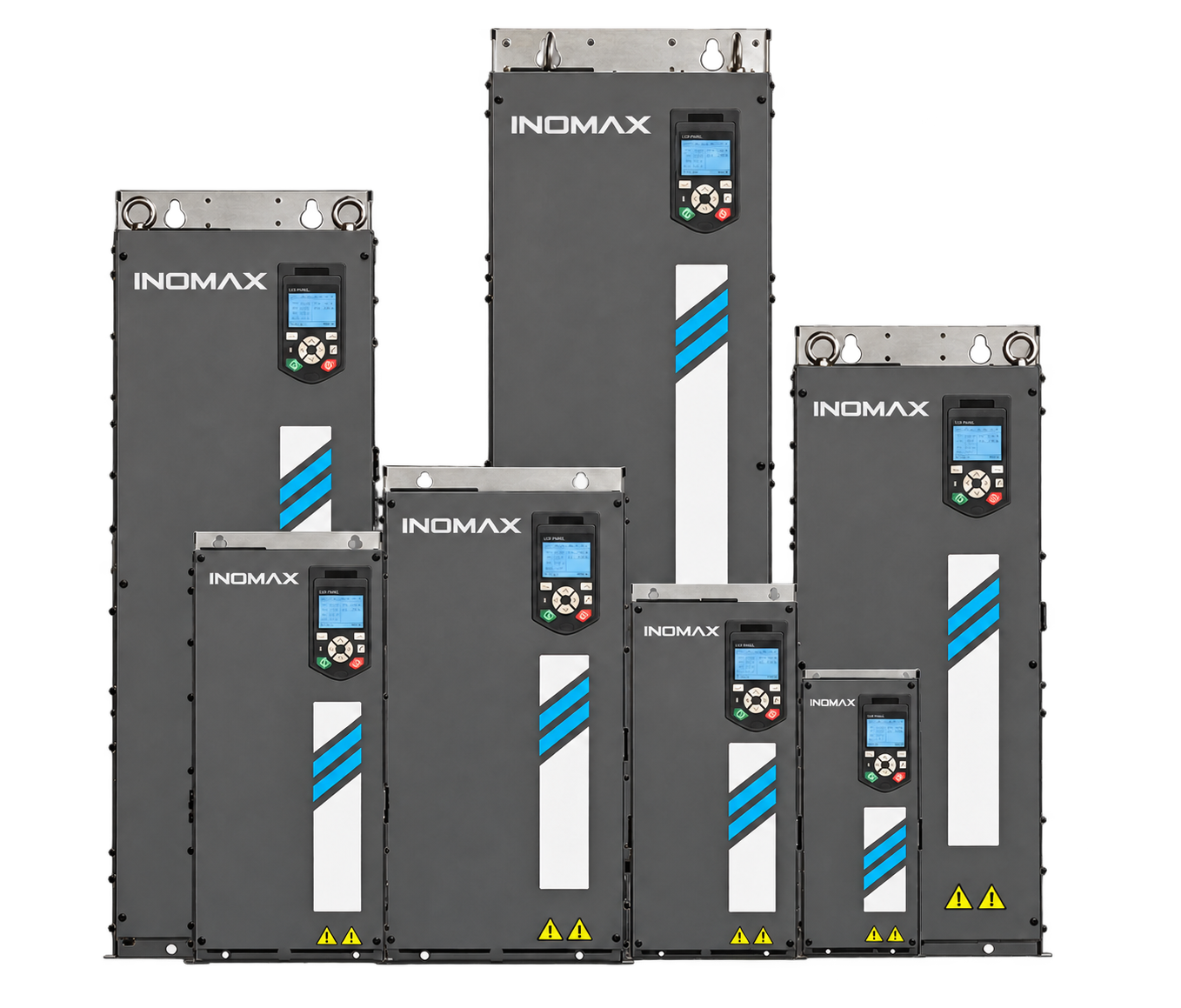
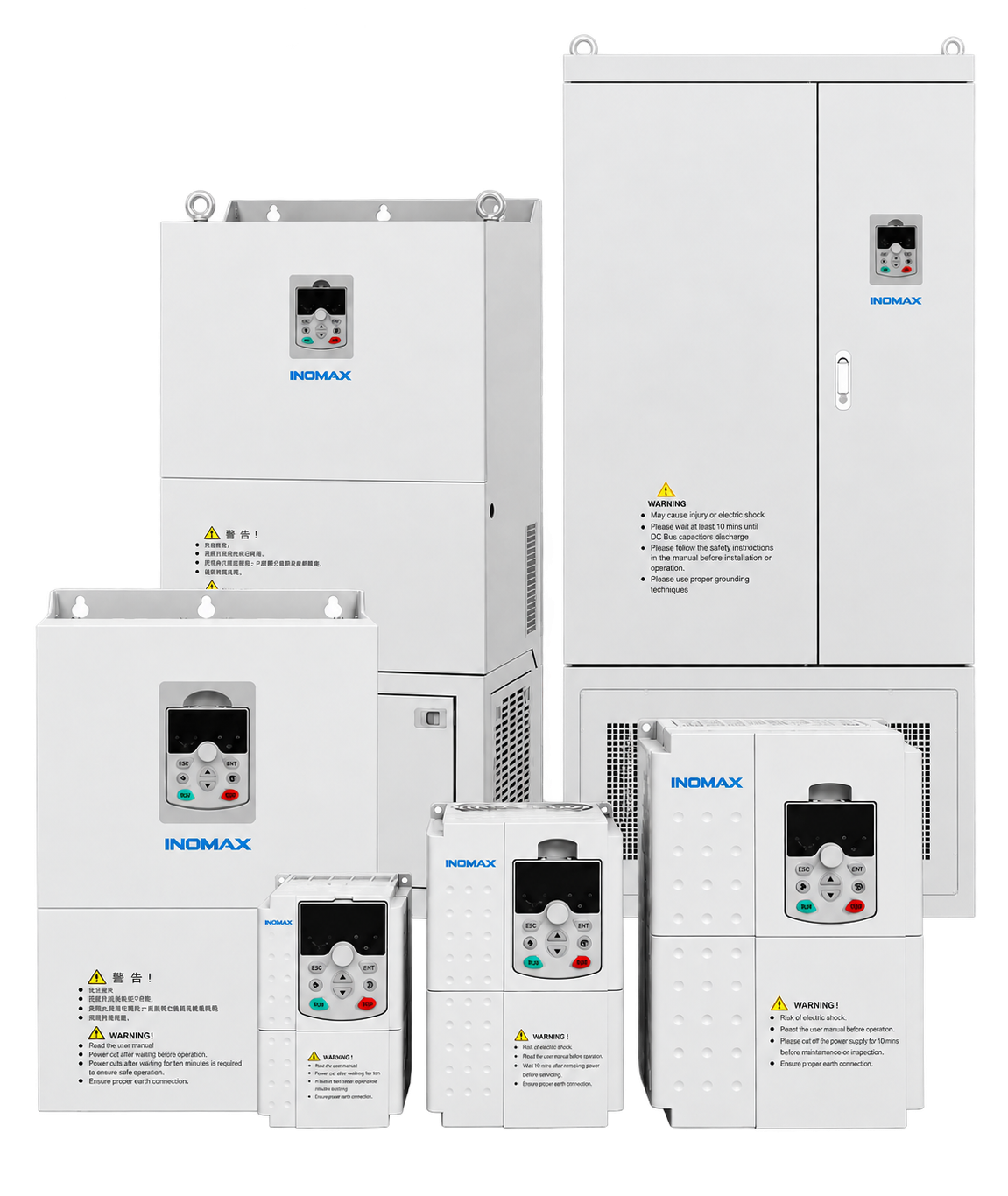
INOMAX MAX500-PV is intended for AC water-pump applications. A DC or brushless-DC pump supplied with its own dedicated controller belongs to a different equipment category. An AC pump inverter should not be assumed suitable for such a motor.
What Does a Solar Water Pumping System Include?
A complete system normally includes the PV array, suitable DC protection and isolation, the solar pump inverter, the AC motor and pump, pipework and the required level or pressure signals. Depending on the installation, water may be delivered directly to irrigation equipment or stored in a tank for later use.
These components must be selected together. A larger array cannot correct a pump that is unsuitable for the required head. A larger motor does not guarantee more useful water if the pipework or source restricts flow. Successful design begins with the required water delivery and works back through the pump, motor, inverter and PV array.
For a borehole, source information includes the static water level, expected pumping level and sustainable yield. For surface-water pumping, consider suction conditions, seasonal water-level changes and the pump’s installation limits. Water availability is part of the design, not an assumption that can be left until commissioning.
How Does a Solar Pump Inverter Work?
Photovoltaic modules generate DC electricity when exposed to sunlight. The inverter’s power-conversion stage supplies the pump motor with the appropriate AC output, while the controller adjusts operation according to available input power and the permitted motor operating range.
In strong sunlight, more power may be available to operate the pump near its required duty point. When irradiance falls, the controller may reduce operating speed or stop if there is insufficient power for useful pumping. The actual response depends on the inverter configuration and the hydraulic system.
Unlike a fixed source of mechanical power, a PV array has an operating voltage and current that change with temperature and sunlight. The controller must manage both the source and the load. That is why a solar pump inverter needs more than a simple motor-power match.
Some product configurations include a voltage-boost stage or support a defined backup input. These are specific design features. They must not be assumed to exist in every solar pump inverter.
What Is MPPT in Solar Pumping?
Maximum power point tracking, or MPPT, is a control function that seeks a useful operating point on the PV array’s voltage-current characteristic. As sunlight and module temperature change, the point at which the array can deliver maximum power also changes.
The pumping controller uses the available electrical power while respecting the motor and inverter limits. Effective tracking can improve use of the energy the array can produce, but MPPT does not create additional sunlight or compensate for an incorrectly sized system.
MPPT efficiency, power-conversion efficiency and total water-pumping efficiency are different quantities. Even excellent electrical tracking does not guarantee a particular daily water volume. Pump efficiency, motor losses, pipe losses, operating head, shading and the hours of useful sunlight all affect the result.
When comparing solutions, ask how the claimed performance was measured and under which operating conditions. Evaluate the full system’s water delivery rather than relying on one efficiency figure.
DC Input Voltage and AC Motor Voltage
The PV input and motor output are separate electrical specifications. A motor rated for a particular AC voltage requires a compatible inverter output; a PV array must also remain within that inverter’s permitted DC voltage and current range.
AC pump motors may use voltage classes such as 220–240 V or 380–480 V, depending on the market and equipment. The motor may be single-phase or three-phase. The correct inverter must explicitly support the motor’s phase configuration and starting requirements; a three-phase-output unit is not automatically compatible with a single-phase pump.
| Specification | Meaning | Design check |
|---|---|---|
| Maximum DC input voltage | The input voltage limit of the selected inverter | Cold-weather array open-circuit voltage must remain within the permitted limit |
| Operating or MPPT voltage range | The range relevant to operation and power tracking | Check array voltage under hot and actual pumping conditions |
| Permitted DC current | The input-current capability of the specified configuration | Check parallel strings and the applicable array-current limits |
| AC output voltage | The motor supply the inverter can provide | Match the motor nameplate and winding connection |
| AC output current | The drive’s motor-current capability | Match motor duty after applying relevant derating |
| Boost capability | A specific voltage-conversion feature | Confirm whether the quoted model includes it and its operating limits |
Do not confuse a startup threshold with a voltage that can support full motor output. A system may have enough voltage to wake the controller but insufficient voltage or power for the required pumping duty.
How Many Solar Panels Does a Water Pump Need?
Panel selection has two related tasks: providing enough energy and arranging modules into electrically compatible strings. Array wattage alone does not resolve either task completely.
Modules connected in series increase string voltage. Parallel strings increase array current. The proposed arrangement must satisfy the selected inverter’s limits over the expected temperature range. Module open-circuit voltage generally rises in cold conditions, while operating voltage generally falls as the modules become hotter.
For illustration, ten identical modules connected in series have approximately ten times one module’s voltage at the same operating condition. Adding a second equivalent string in parallel approximately doubles the available current at that voltage. This explains the arrangement; it is not a recommended string design without the module data and inverter limits.
Estimate required daily energy from the pumping duty and system losses, then use location-specific solar conditions to assess array size. Consider seasonal demand, shading and the useful operating hours. A fixed panel-to-motor wattage multiplier can be an initial estimate, but should not replace the voltage, current and water-delivery calculations.
Flow Rate, Total Dynamic Head and Pump Selection
Flow rate describes how much water is delivered per unit time. Total dynamic head describes the hydraulic requirement the pump must overcome at that flow. It can include elevation difference, required delivery pressure and friction losses in the pipework.
Borehole depth is not automatically the total dynamic head. The pumping water level, drawdown, destination elevation and pipe losses all matter. A borehole that is deep but has a relatively high water level can impose a different pumping duty from one with a lower dynamic level.
The pump curve shows the relationship between flow and head for a defined operating condition. Review where the system operates on this curve and whether lower-speed operation remains useful. A pump may rotate while producing little or no delivery if it cannot overcome the required head.
Daily water demand should be stated directly. If an application needs 60 cubic metres per day, the design must show how that volume can be delivered within the available operating period and source limits. Dividing by a nominal number of sun hours is only a starting estimate because sunlight and pump output vary throughout the day.
Where Are Solar Pump Inverters Used?
| Application | Main objective | Important requirement |
|---|---|---|
| Agricultural irrigation | Supply water to crops during the required season | Daily volume, irrigation pressure and seasonal solar conditions |
| Borehole and deep-well pumping | Lift groundwater to the surface or storage | Dynamic water level, pump curve, source yield and motor cable |
| Livestock watering | Maintain a reliable water supply for animals | Storage capacity, tank-level signals and low-water protection |
| Rural water supply | Transfer water where electrical infrastructure is limited | Demand profile, storage, maintenance access and source reliability |
| Reservoir or tank filling | Move water during periods of available solar power | Transfer head, overflow prevention and usable storage volume |
| Remote farms and estates | Use local solar energy for compatible AC pumping equipment | Environmental protection, monitoring and any backup arrangement |
Each application has a different priority. Irrigation may require a defined pressure, while tank filling may allow more flexibility in the pumping schedule. The same motor power can therefore lead to different array, pump and control selections.
Dry-Run Protection, Tank Levels and System Monitoring
A pump should not continue operating outside the conditions permitted by its manufacturer. Low source-water level, a dry well, restricted flow or a full destination tank can require the controller to change operation or stop.
Dry-run protection may use a sensor, electrical measurements or another detection method, depending on the product. Confirm the actual implementation, its limitations and the commissioning procedure. A protection function should be matched to the installation rather than assumed to work identically on every pump.
Tank-level signals can help prevent overflow or coordinate filling. Cable routing, signal type and fault behaviour need to be defined, especially when sensors are far from the inverter. Where remote monitoring is required, specify the communication hardware and which measurements or alarms must be available.
Record useful operating information: DC voltage, motor current, output frequency, water delivery and fault history where supported. These records help distinguish limited sunlight from a hydraulic restriction or an electrical configuration issue.
Installation, Long Motor Cables and Backup Power
Outdoor installations require an enclosure and mounting arrangement suitable for the actual conditions. Consider direct sunlight, ambient temperature, rain, dust, ventilation and maintenance access. An enclosure rating alone does not establish that any mounting location is acceptable.
For a submersible motor, cable length can affect voltage drop and motor-terminal electrical stress. Cable size, motor insulation and any output reactor or filter must be reviewed with the selected inverter. Do not choose an accessory solely from a generic cable-distance rule.
PV strings remain capable of producing hazardous DC voltage in daylight. Installation, isolation and testing must follow the equipment documentation and applicable electrical requirements. Protective devices need to be suitable for the actual DC or AC circuit.
Backup operation from a grid supply or generator is configuration-specific. PV and AC sources must not be connected together through an improvised arrangement. Specify the permitted inputs, transfer logic, protection and source-interlocking requirements before installation.
Water storage can separate pumping time from water-use time. Battery storage is a different electrical design question and should not be assumed necessary or compatible with every solar pumping inverter.
Selecting an INOMAX MAX500-PV Configuration
Prepare the motor nameplate, pump curve, required daily water volume, target flow, total dynamic head and installation location. Include the expected dynamic water level for borehole applications and describe any variation between seasons.
For the electrical review, provide the PV module datasheet, proposed series and parallel arrangement, available array space, motor cable length and any existing equipment that must be reused. State the desired enclosure, level inputs, monitoring and backup-power requirements.
INOMAX MAX500-PV is the dedicated solar pumping family for compatible AC pump motors. The selected version must match the PV input range, motor output and application environment. Voltage boost, enclosure protection and additional interfaces must be confirmed as part of the actual configuration.
Read the solar pump inverter selection guide for AC water pumps. Send the application data to info@inomaxtechnology.com for a model-specific review.
Frequently Asked Questions About Solar Pump Inverters
Can a solar pump inverter operate an existing AC water pump?
Potentially, if the motor, pump duty and inverter configuration are compatible. Provide the nameplate and pump curve before selecting a model.
Does the system need batteries?
Not necessarily. Some applications pump during available sunlight and store water. Any requirement to operate outside those hours must be addressed in the system design.
Why does the pump deliver less water on cloudy days?
Less solar power may be available, reducing useful operating speed or runtime. The hydraulic system determines how that change affects water delivery.
Can I add more panels to solve every performance problem?
No. The array must remain within electrical limits, and poor delivery may result from the pump, pipework, water level or configuration.
Can I use a DC or BLDC pump?
Do not assume compatibility. MAX500-PV is intended for compatible AC pump motors; dedicated DC pumping systems require their own controllers.
Is motor power enough to calculate panel quantity?
No. Module ratings, string voltage, available solar energy, operating head and required water volume also matter.
What if the motor runs but no water arrives?
Check operating records and have qualified personnel review water level, pump condition, valves, delivery head and the approved setup. Do not repeatedly run a pump under unsuitable conditions.
Can grid and PV power be used simultaneously?
Only where the exact equipment and approved system design support that operation. Confirm the input architecture and protections before making connections.