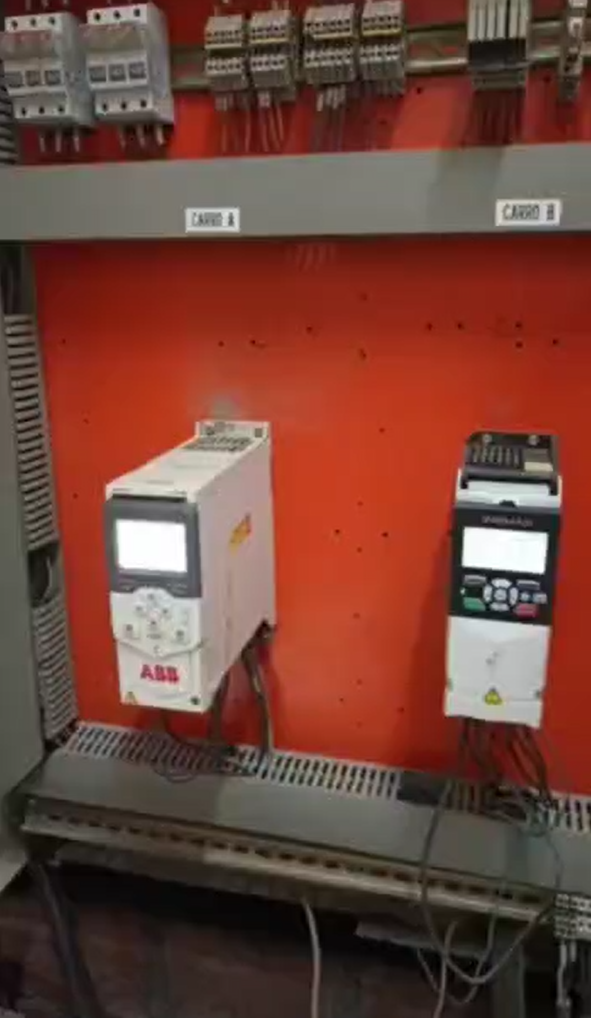
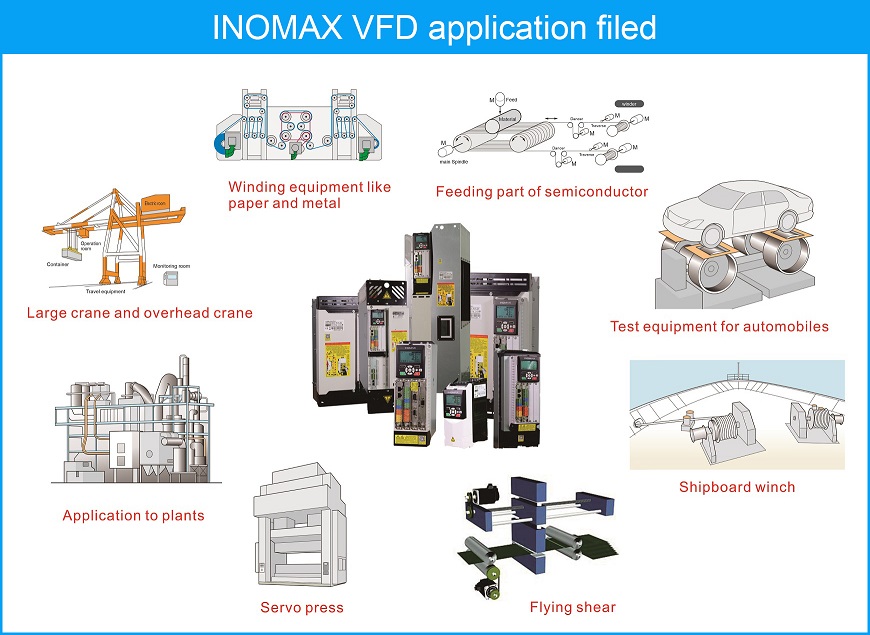
ACS580 & ACS880 for Multi-Axis Control
Precision Synchronization for Printing, Packaging, Paper, Web Converting & General Automation
Overview
Modern production machinery rarely works alone. From a 6‑color printing press and a high‑speed pouch making machine to a paper machine with 40 dryer sections and a slitter‑rewinder, every machine relies on multiple axes running in perfect harmony. The difference between a world‑class production line and a problematic one is often the quality of its multi‑axis synchronization.
At Inomax Technology, we deliver multi‑axis control solutions using our ACS580 (advanced vector control) and ACS880 (Direct Torque Control) drive platforms. Our technologies — including high‑speed drive‑to‑drive (XD2D) links, real‑time industrial Ethernet (Profinet IRT, EtherCAT) and common DC bus — enable microsecond‑level synchronization across tens or hundreds of axes, matching or exceeding dedicated motion control systems from ABB, Rockwell or Danfoss, at a significantly lower total cost of ownership.
What we mean by “multi‑axis control” in this page:
-
Electronic line shaft – replace mechanical shafts on printing presses, paper machines, coating lines
-
Electronic gearing – synchronize multiple conveyors, rotary knives, winding stations
-
Master‑follower torque sharing – multiple motors on one load (e.g., long conveyors, large drums)
-
Electronic cam (flying shear) – rotary cutters, cross cutters, reciprocating feeders
-
Common DC bus energy sharing – reuse regenerative energy among motoring axes
Multi‑Axis Control Technologies – ACS580 vs ACS880
| Feature | ACS580 | ACS880 |
|---|---|---|
| Synchronization methods | XD2D (electrical), Modbus, Profibus, Profinet, EtherCAT (opt) | XD2D (electrical/fiber), Profinet IRT, EtherCAT, EtherNet/IP, CANopen |
| Max followers per master | Up to 10 (XD2D) | Up to 60 (XD2D) / network limited (fieldbus) |
| Sync accuracy | <5 ms torque response | <5 ms torque response; <1 µs position sync (fieldbus) |
| Control modes | Speed, torque, position (incremental encoder) | Speed, torque, position, electronic gearing, electronic cam |
| Encoder support | Incremental (TTL/HTL) | Incremental, resolver, absolute (EnDat, Hiperface, BiSS, SSI) |
| Load sharing | Basic (droop) | Advanced (master‑follower torque control, droop) |
| Electronic cam (flying shear) | No | Yes (built‑in, 64 points/rev) |
| Regenerative AFE | No | Yes (ACS880 AFE series) |
| Safe Torque Off (STO) | SIL3 built‑in | SIL3 built‑in |
Core Synchronization Architectures
1. Master‑Follower via XD2D (Drive‑to‑Drive)
-
Dedicated link (electrical up to 50 m, fiber optic up to 200 m)
-
One master broadcasts torque/speed to up to 60 followers (ACS880)
-
Ideal for paper machine sections, long conveyors, crushers, mixers
2. Fieldbus‑Based Synchronization (Profinet IRT / EtherCAT)
-
<1 µs (Profinet IRT) or <100 ns (EtherCAT) sync accuracy
-
Supports hundreds of drives on one network
-
Perfect for printing presses, packaging lines, web converting, electronic line shaft
3. Electronic Gearing (Position Synchronization)
-
Follower position locked to master position with programmable gear ratio
-
Ratio can be changed on the fly (e.g., 2.345:1)
-
Used in rewinder‑slitter, conveyor zones, rotary knife
4. Electronic Cam (Flying Shear) – ACS880 only
-
Built‑in cam profile generator (up to 64 points per revolution)
-
Synchronization zone + return zone programming
-
Eliminates external motion controller for cut‑to‑length, rotary die cutter, reciprocating feeder
5. Load Sharing (Multiple Motors, One Load)
-
Torque control method – master in speed, followers in torque → perfect load balance
-
Droop method – all drives in speed with droop → self‑balancing, no encoder
-
Used on press rolls, long belt conveyors, centrifuge drives
6. Common DC Bus
-
Energy flows freely between motoring and regenerating axes
-
Reduces line current, saves energy, simplifies braking
-
Ideal for winders, test benches, cranes, elevators
Relevant Application Case Studies (Multi‑Axis Coordination)
Case Study 1: 8‑Color Gravure Printing Press – Electronic Line Shaft
Industry: Printing & packaging
Machine: 8‑color rotogravure press (unwind, 8 print stations, outfeed, rewind) – 11 axes
Challenge: Traditional mechanical line shaft limited speed, required manual register adjustments, and caused high waste during changeovers.
Solution: ACS880 drives on all 11 axes, connected via Profinet IRT. One master drive (reel) broadcasts speed reference to all followers with <1 µs skew. Electronic gearing with individual draw settings compensates for paper stretch and thermal expansion. Optical register sensors feed directly to each station’s drive for real‑time advance/retard (0.01° resolution).
Results:
-
Register accuracy ±0.05 mm at 400 m/min across all 8 colors
-
Job changeover reduced from 45 min to 12 min (electronic draw adjustment)
-
Waste (misprints) reduced by 65%
-
Line speed increased by 18%
Case Study 2: High‑Speed Pouch Making Machine – Electronic Cam (Flying Knife)
Industry: Flexible packaging
Machine: Vertical form‑fill‑seal (VFFS) with rotary cross cutter, 120 cuts/min, cut length 150–400 mm
Challenge: Existing clutch‑brake system caused length variation ±3 mm and frequent mechanical wear. PLC‑based flying shear was too slow for 120 cuts/min.
Solution: Single ACS880 drive configured with electronic cam (flying shear). Master encoder from film pull belt. Cam profile: synchronization zone 0–180° (cutter matches film speed), return zone 180–360° (fast return). Cut length changed via HMI – drive automatically recalculates cam.
Results:
-
Cut length accuracy improved to ±0.5 mm
-
Cycle rate increased to 140 cuts/min (17% faster)
-
Clutch‑brake assembly eliminated – maintenance cost reduced by 80%
-
Commissioning time: 2 hours (vs. 2 days with external motion controller)
Case Study 3: Paper Machine Dryer Section – Multi‑Drive Speed Chain
Industry: Paper making
Machine: 3.6 m kraft paper machine, dryer section with 42 driven cans divided into 6 drive groups
Challenge: Each dryer group must maintain exact draw (speed difference) relative to the previous group. Old DC drive system had ±0.3% speed error causing sheet breaks and wrinkles.
Solution: ACS880 drives on all 42 cans, grouped into 6 master‑follower sections. Each section has one master (speed control), others as followers (torque control) – load sharing across multiple cans in same section. Master‑to‑master synchronization via Profinet IRT with programmable draw values (e.g., group 2 = group1 speed × 1.008).
Results:
-
Speed regulation improved to ±0.01% (encoder feedback)
-
Sheet break frequency reduced by 55%
-
Draw values can be adjusted online via DCS – no stopping
-
Energy savings: 12% due to common DC bus and AFE regeneration on main sections
Case Study 4: Slitter‑Rewinder with Dual‑Motor Winding – Electronic Gearing & Load Sharing
Industry: Film & foil converting
Machine: Slitter‑rewinder, 1.6 m width, 600 m/min, center‑wind with two rewind stations (alternating)
Challenge: Two rewind stations must index (change rolls) without stopping the line. The rewind drive must switch between torque control (winding) and speed control (transfer) seamlessly.
Solution: Two ACS880 drives (rewind A & B) configured as followers to the main line speed master. Electronic gearing during winding (rewind speed = line speed / roll diameter). Load sharing when both stations wind simultaneously (split width). Transfer sequence programmed via drive digital I/O – no PLC intervention for timing-critical steps.
Results:
-
Roll change completed in 3 seconds without line stop
-
Taper tension accuracy ±2% (load cell feedback)
-
End‑face uniformity improved – telescoping eliminated
-
Energy reuse: rewind regenerates during acceleration – energy shared via common DC bus with other drives
Case Study 5: Carton Folding‑Gluing Machine – Multi‑Conveyor Electronic Gearing
Industry: Corrugated packaging
Machine: Folder‑gluer with 5 independently driven conveyor zones (feed, pre‑fold, folding, compression, counter‑stacker)
Challenge: Conveyors must maintain exact speed ratios to avoid jams or overlapping. Mechanical line shaft was noisy, inflexible and required frequent maintenance.
Solution: ACS580 drives on all 5 zones. One master drive (folding section) broadcasts speed reference to all followers via XD2D link. Each follower has programmable gear ratio (e.g., compression zone = 0.98 × master speed for slight compaction). Smooth S‑curve acceleration prevents product shifting.
Results:
-
Speed ratio changes available via HMI – no mechanical changes
-
Jam rate reduced by 70%
-
Conveyor belt life extended by 40% (reduced slip)
-
Noise level reduced by 12 dB
Case Study 6: Metal Slitting Line – Common DC Bus with Regen
Industry: Metal service center
Machine: Slitting line for 1.5 mm steel coil – unwinder (regenerating), slitter (motoring), rewinder (motoring)
Challenge: Unwinder constantly regenerates (energy flows back). Traditional system used braking resistors – wasted energy and generated heat. Harmonic distortion exceeded utility limits.
Solution: Three ACS880 AFE drives sharing a common DC bus. Unwinder regenerates directly onto DC bus; slitter and rewinder consume that energy. Only net power flows to/from grid via one AFE front end. THDi <5% and unity power factor.
Results:
-
Energy consumption from grid reduced by 78% (regenerated energy reused)
-
Braking resistors eliminated – no heat in electrical room
-
Power factor improved from 0.75 to 0.99
-
Utility penalties for harmonics removed
-
Payback period: 11 months
Case Study 7: Coating & Laminating Line – Dual Unwind Tension Master‑Follower
Industry: Paper & film coating
Machine: Laminator with two unwinds (paper + film), one nip roll, one rewind
Challenge: Both unwinds must maintain independent tension while the nip roll controls line speed. Unwind motors regenerate, causing DC bus overvoltage without proper control.
Solution: ACS880 master (nip roll) in speed control. Unwind A & B drives in torque control, receiving torque reference from master – but with independent tension PID overrides. All three drives on common DC bus – regenerative energy from unwinds directly powers nip roll motor.
Results:
-
Tension variation reduced from ±12% to ±3% on both webs
-
Laminated product curl eliminated
-
Energy consumption from grid reduced by 65%
-
Production speed increased from 250 to 320 m/min (28% gain)
Case Study 8: Textile Finishing Range – Multi‑Zone Speed Synchronization
Industry: Textile
Machine: Tentering range (heat setting) with 6 driven zones – entry, overfeed, pin chain (2 zones), exit, winder
Challenge: Fabric shrinkage varies across zones. Speed ratios must be adjusted frequently based on fabric type. Mechanical line shaft with variable pulleys was labor‑intensive and imprecise.
Solution: Six ACS580 drives with electronic gearing via Profinet. Master drive (exit zone) speed reference broadcast to all others. Each zone has programmable overfeed/underfeed percentage (e.g., +0.5%, -1.2%). Operator changes ratios via HMI – drives update instantly.
Results:
-
Changeover time between fabric types reduced from 45 min to 8 min
-
Fabric width uniformity improved (reduced edge curling)
-
Drive energy consumption 18% lower than variable pulley system
-
Maintenance cost reduced by 60% (no pulleys, belts or gearbox adjustments)
Case Study 9: Palletiser Infeed – Electronic Line Shaft for Conveyor Zones
Industry: Logistics / beverage
Machine: Palletiser infeed system – 8 conveyor zones feeding two palletising stations, each with accumulating function
Challenge: Conveyors must start/stop in sequence to avoid product collision, but also run synchronously during steady flow. Traditional approach used many contactors and complex PLC logic.
Solution: Eight ACS580 drives configured as master‑follower with independent start/stop and electronic gearing during run. Each zone follows the previous zone’s speed but can be decoupled via digital input (accumulation mode). PLC only sends “run” and “zone full” signals – all speed coordination handled by drives.
Results:
-
PLC code simplified by 70% (no conveyor speed coordination logic)
-
Throughput increased by 15% (smoother acceleration)
-
Energy savings: zones stop individually when full – no idling
-
Commissioning time: 2 days (vs. 2 weeks with traditional method)
Case Study 10: Robotic Gantry – 3‑Axis Synchronisation (Pick & Place)
Industry: General automation
Machine: Cartesian gantry robot (X, Y, Z axes) for pick‑and‑place of 5 kg boxes, 30 cycles/min
Challenge: Inexpensive solution needed – traditional servo system was over‑specified and expensive. Required coordinated motion with S‑curve ramps and precise positioning.
Solution: Three ACS880 drives (ACS880‑01‑004A‑4 for Z, 2 × ACS880‑01‑005A‑4 for X/Y) with incremental encoders. Electronic gearing between X and Y for diagonal moves. PLC sends target positions via Modbus TCP; drives execute positioning with built‑in point‑to‑point motion engine.
Results:
-
Total drive + motor cost 55% lower than equivalent servo system
-
Positioning accuracy ±0.5 mm (within specification)
-
Cycle rate achieved 32 cycles/min (better than target)
-
Standard AC motors used – readily available spare parts
Why Choose Inomax Technology for Multi‑Axis Control?
| Advantage | Benefit |
|---|---|
| Direct Torque Control (ACS880) | Full torque at zero speed, <5 ms torque response – no encoder needed for many applications |
| Flexible sync architectures | XD2D (up to 60 drives), Profinet IRT (<1 µs), EtherCAT (<100 ns) – choose the right tool |
| Unified platform from 0.55 kW to 6 MW | Same programming, same fieldbus, same tools for all axes – simplify engineering and spare parts |
| Built‑in electronic cam & gearing | No external motion controller needed for many flying shear / indexing applications |
| Regenerative AFE option | <5% THDi, unity power factor, >95% energy recovery – meets IEEE 519 |
| Cost‑effective alternative | 20‑30% lower cost than Rockwell or Siemens multi‑axis systems, with equal or better performance |
| Global engineering support | Pre‑sales sizing, integration consulting, on‑site commissioning, 24/7 diagnostics |
Frequently Asked Questions
Q1: What is the maximum number of drives I can synchronise with ACS880?
Using XD2D drive‑to‑drive link: one master can control up to 60 followers. Using Profinet IRT or EtherCAT, the limit is network‑dependent (typically 256+ drives). For very large systems, hierarchical master‑follower configurations are possible.
Q2: Do I need a PLC for multi‑axis synchronization?
Not for basic speed/torque synchronization (master‑follower via XD2D). For electronic gearing, electronic cam or position control, you typically need a PLC or HMI to set gear ratios / cam parameters, but the real‑time synchronization is handled by the drives themselves.
Q3: Can I mix ACS580 and ACS880 drives in one multi‑axis system?
Yes. Both support common fieldbus protocols (Profinet, EtherCAT, Modbus TCP). However, for the highest synchronization accuracy and for electronic cam, we recommend using ACS880 across all axes.
Q4: How do I set up electronic gearing on ACS880?
Parameter group 25 (Position control). Set follower to “Electronic gear” mode, define master encoder source, gear ratio numerator and denominator. The drive automatically maintains the ratio even during speed changes. Gear ratio can be changed on the fly via fieldbus.
Q5: What accuracy can I expect with electronic cam (flying shear)?
With a 1024 PPR encoder on the master axis and a good mechanical design, cut length accuracy of ±0.5 mm at 300 m/min is typical. Accuracy depends on encoder resolution, mechanical stiffness, and inertia ratio.
Q6: How does common DC bus reduce energy costs?
When one axis regenerates (brakes), that energy normally goes to a braking resistor and becomes heat. On a common DC bus, the energy is available to other axes that are motoring. Only the net energy difference flows to/from the grid. Savings of 15‑30% are typical in mixed load applications like winders, test benches or elevators.
Q7: What fieldbus adapters do you recommend for multi‑axis?
-
Profinet IRT – FENA‑21 adapter (dual port, MRP support). Best for Siemens‑based systems.
-
EtherCAT – FECA‑01 adapter. Best for Beckhoff, Omron, CODESYS.
-
EtherNet/IP – FENA‑21 adapter. Best for Rockwell.
-
XD2D – Built into ACS880. Best for pure drive‑to‑drive without PLC.
Q8: Can I use ACS880 for position control of a rotary table?
Yes. ACS880 supports absolute positioning using an encoder (incremental or absolute). You can home, move to absolute/relative positions, and set acceleration/deceleration ramps. Position accuracy is ±1 encoder count.
Q9: What is the typical commissioning time for a multi‑axis system?
For a master‑follower system with 10 drives, one day. For a flying shear application, two days including mechanical tuning. We provide pre‑configured parameter files and sample PLC code to accelerate your project.
Q10: How does your solution compare to Danfoss VLT Multiaxis Servo Drive MSD 510?
Danfoss MSD 510 is a dedicated multi‑axis servo system with decentralised drives, ideal for high‑dynamic packaging machines. Our ACS880 is a modular AC drive that also supports multi‑axis synchronisation (electronic gearing, cam) but with higher power capability (up to 6 MW) and standard AC motors. For high‑power (>50 kW) or standard motor applications, ACS880 is more cost‑effective. For low‑power (sub‑10 kW) ultra‑high dynamic servo applications, Danfoss MSD 510 may be a better fit. We are happy to help you compare based on your specific cycle rate and inertia requirements.
Ready to Synchronise Your Production Line?
From 2 drives to 200, our engineers are ready to help you design the optimal multi‑axis control architecture – electronic line shaft, electronic gearing, flying shear or load sharing.
Contact us today for:
-
Free multi‑axis system assessment
-
Custom electronic cam profiles for your cut‑to‑length line
-
GSDML/ESI/EDS files and sample PLC code
-
Retrofit proposal for replacing mechanical line shafts
Inomax Technology