INOMAX PTO880/ ACS880 Shore Power Solutions
High-Performance Shore-to-Ship Frequency Converters for Zero-Emission Ports
Overview
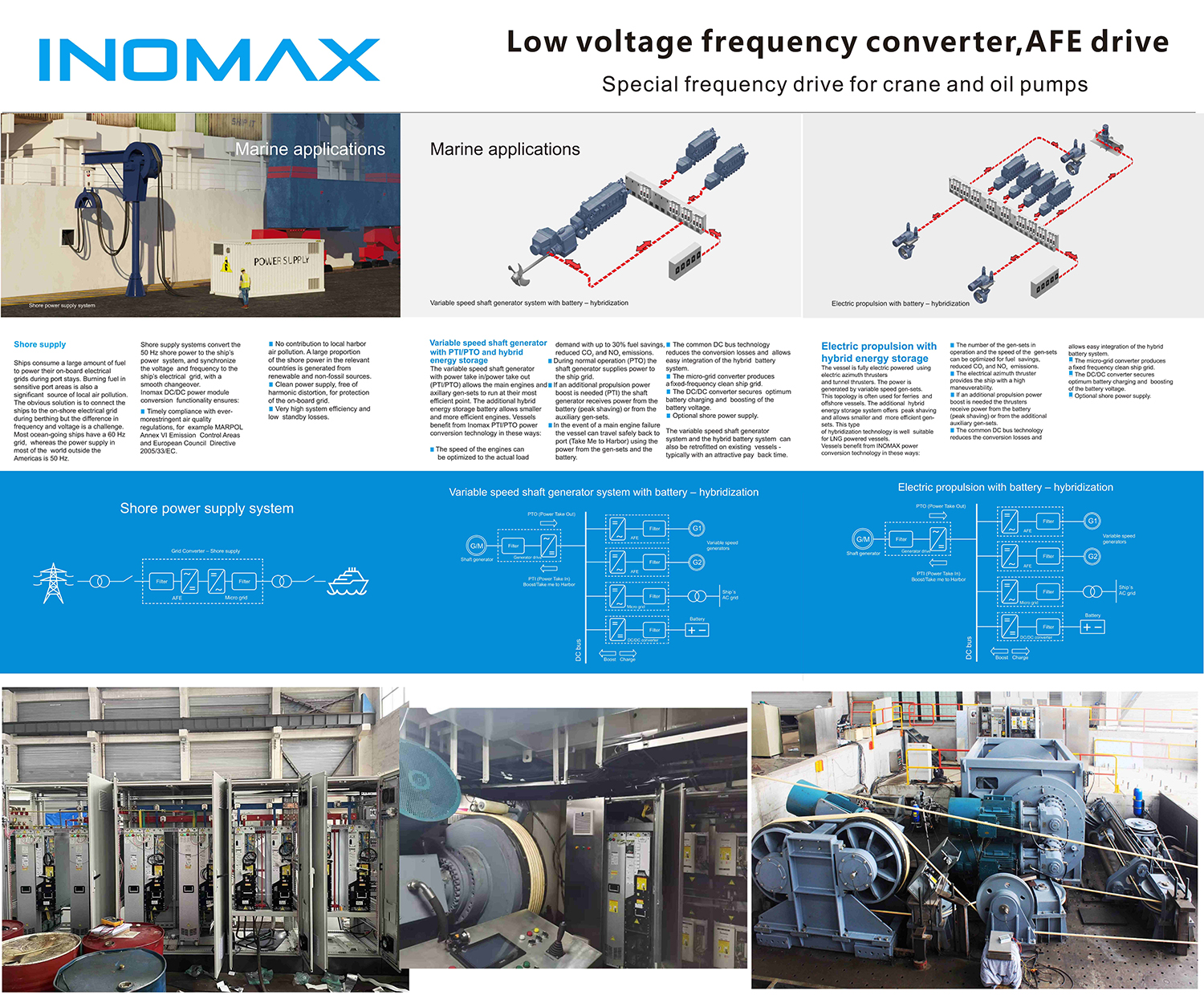
Shore power — also known as Cold Ironing, Onshore Power Supply (OPS), or Shore-to-Ship (STS) — is the technology that enables vessels to shut down their diesel-fueled auxiliary engines while docked and connect to the land-side electrical grid. The method of supplying electrical energy to ships from shore power stations has been practiced for decades, but it is now becoming a critical requirement under new environmental regulations worldwide–. When a ship is at berth, its auxiliary engines continue to run to power onboard systems — producing harmful emissions (NOₓ, SOₓ, CO₂) and noise pollution directly in densely populated port areas.
As of March 2027, the IMO Net-Zero Framework enters into effect, requiring ships to reduce their greenhouse gas fuel intensity. Under these regulations, electricity delivered to the ship from shore power is counted as zero-emission energy, making shore power compliance essential
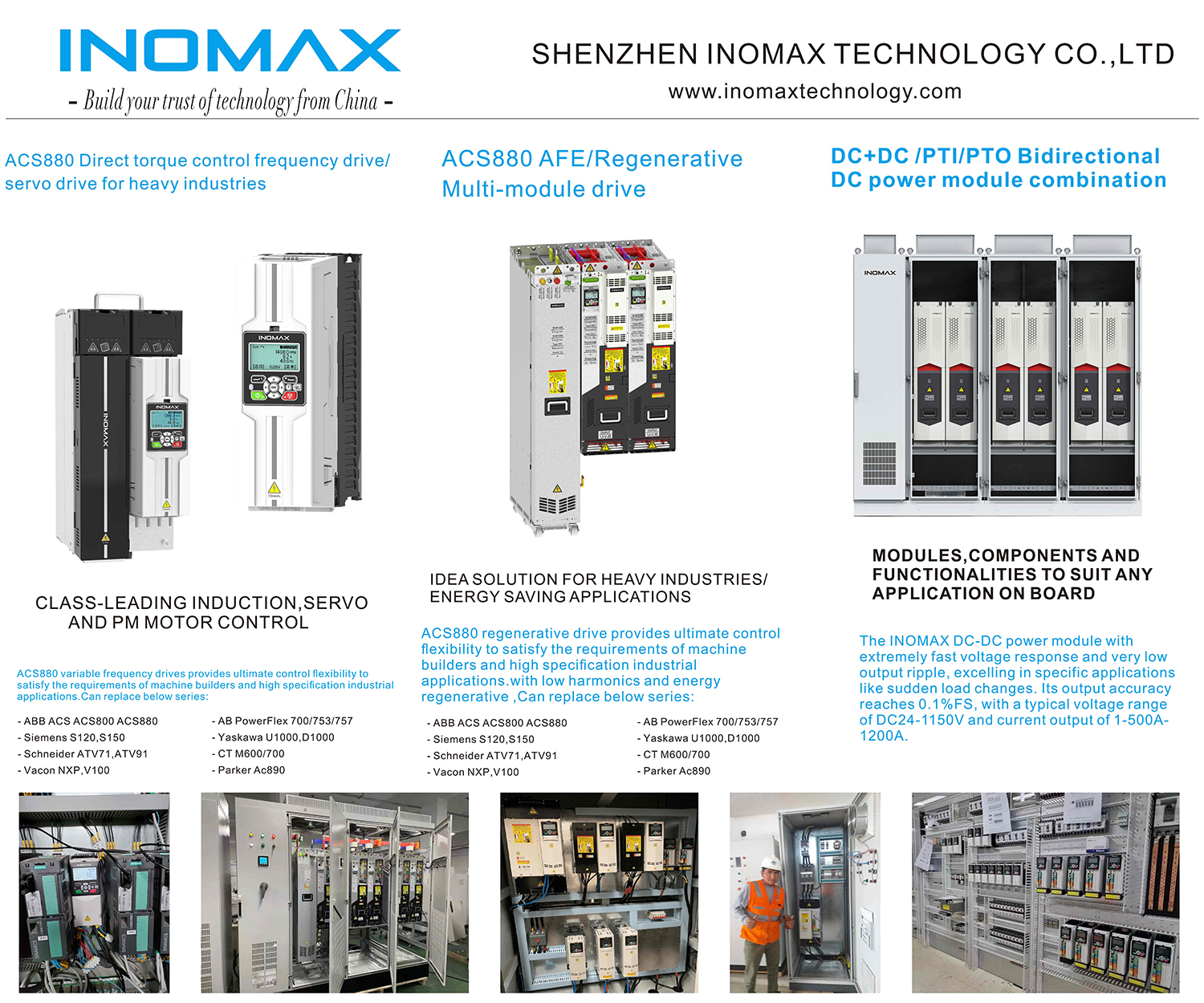
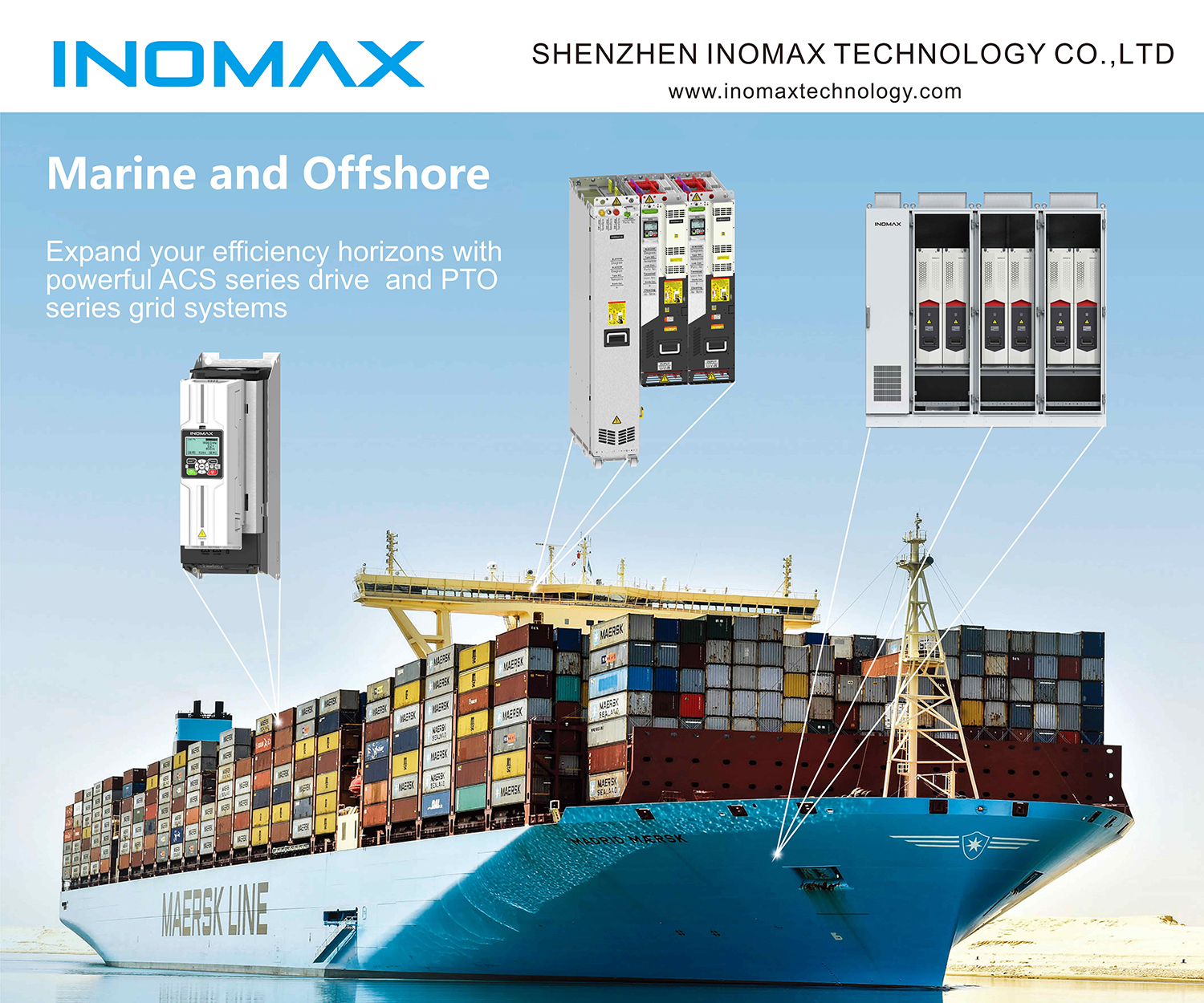
At Inomax Technology, we provide dedicated shore power frequency converter solutions using our ACS580 (cost-effective, lower power) and ACS880 (high-performance with Direct Torque Control, active front end) drive platforms. Our ACS880 AFE (Active Front End) multidrives are the heart of our shore power systems — converting the voltage and frequency of the shore grid to match onboard requirements with exceptionally low harmonic content, ensuring no disturbance to the local grid or shipboard systems
What we deliver for shore power:
-
Static frequency conversion — Converts 50 Hz shore grid to 60 Hz for vessels (or 60 Hz to 50 Hz), supporting both low-voltage (≤1 kV) and high-voltage (1 kV to 15 kV) applications
-
Ultra-low harmonic AFE technology — THDi <3% at typical loads, protecting sensitive shipboard equipment and meeting IEEE 519 grid code requirements without external filters
-
Seamless grid synchronization — Active Front End (AFE) with built-in grid-forming capability and phase-locked loop technology for shock-free connection
-
Containerized or centralized solutions — Pre-engineered, fully integrated shore power stations for rapid deployment, from 500 kVA to 50 MVA
-
Parallel operation — Multiple frequency converters can operate in parallel to deliver higher power or provide N+1 redundancy for mission-critical ports
-
Modular design for maximum flexibility — Our ACS880 multidrive architecture supports container-based shore power units with heating, ventilation, and intuitive HMI for easy connection
-
Compliance with IEC/IEEE 80005 standards — Fully compliant with international requirements for high-voltage shore connection (HVSC) systems
Why Shore Power? The Regulatory and Environmental Imperative
The global maritime industry is under unprecedented pressure to decarbonize. The IMO Net-Zero Framework, formalized at MEPC 83 in April 2025 and scheduled for formal adoption in October 2025, introduces binding GHG fuel intensity reduction targets. Under MARPOL Annex VI, all ships above 5,000 gross tonnage must report their annual energy usage, including power at berth and shore power usage as mandatory data fields in SEEMP Part II reports Shore power adoption is no longer optional — it is a regulatory requirement.
Furthermore, the ISO/IEC/IEEE 80005 series defines the technical requirements for interoperability and safety of high-voltage shore connection (HVSC) systems, covering everything from shore distribution systems to frequency converters and shipboard interfaces. Compliance with these standards is mandatory for ports and vessels seeking to implement shore power.
Key benefits of shore power:
| Benefit | Description |
|---|---|
| Zero emissions at berth | Eliminates up to 1,000 liters of diesel per day per vessel — a typical cruise ship emits as much NOₓ in one day at berth as 5,000 cars on the road |
| Quiet ports | Eliminates noise and vibration from auxiliary engines — essential for urban ports and residential areas |
| Regulatory compliance | Meets IMO, EU, CARB, and local port authority requirements; shore power electricity counts as zero-emission under the IMO Net-Zero Framework |
| Fuel cost savings | Typically 30-50% lower cost than generating power onboard using diesel |
| Extended engine life | Reduces operating hours on auxiliary engines, lowering maintenance costs |
| Improved local air quality | Eliminates NOₓ, SOₓ, and particulate matter emissions in port communities |
Core Technologies for Shore Power Frequency Conversion
Static Frequency Conversion with AFE Technology
Our ACS880 AFE drives form the core of our shore power solutions. Unlike rotating frequency converters (motor-generator sets), static converters using IGBT-based active front ends offer higher efficiency (typically >97%), lower maintenance, and smaller footprint.
How it works:
-
Input conversion stage — Active front-end rectification converts shore AC power to DC while eliminating frequency differences and suppressing input harmonics. THDi is maintained below 3%, ensuring no disturbance to the local port grid
-
Output conversion stage — Space Vector Pulse Width Modulation (SVPWM) technology inverts DC power back to AC at the vessel’s required frequency (50 Hz or 60 Hz) and voltage. Voltage accuracy is ±0.5% with minimal phase synchronization error
-
Intelligent control layer — Phase-locked loop (PLL) technology and soft-start functionality enable shock-free grid connection between shore power and the ship’s electrical system, with fault response times reduced to the 10-millisecond range
Active Front End (AFE) — The Key to Low Harmonics
AFE technology uses IGBT-based active rectification instead of passive diodes, shaping the input current waveform to be sinusoidal and in phase with the voltage.
Key AFE benefits for shore power:
-
THDi <3% at 80-100% load — Eliminates harmonic interference with shipboard navigation and communication equipment
-
Unity power factor (>0.99) — Maximizes utilization of port grid capacity
-
Bidirectional power flow — Supports future V2G (vessel-to-grid) applications if vessel has battery storage
-
Meets IEEE 519 and IEC 61000 — Compliant with strictest harmonic standards without external filters
Grid-Forming Capability for Microgrid Stability
When multiple shore power converters operate in parallel, or when the port operates in island mode, our ACS880 drives support grid-forming (GFM) control. GFM converters maintain voltage and frequency stability without relying on a strong utility grid. In parallel connection, virtual impedance technology prevents instabilities regardless of the impedance seen from output terminals, ensuring reliable shore-to-ship power delivery
Parallel Operation for Scalability
Our ACS880 multidrives can be configured to operate in parallel, allowing:
-
Scalable power — Start with 500 kVA, expand to 50 MVA as demand grows
-
N+1 redundancy — One additional module provides backup if any module fails
-
Load sharing — Balanced power distribution across all active modules
-
Hot standby — Modules can be taken offline for maintenance without interrupting service
Containerized vs. Centralized Solutions
| Configuration | Best For | Features |
|---|---|---|
| Containerized | Smaller ports, temporary installations, rapid deployment (4-6 weeks from order to operation) | Fully integrated in standard ISO container, walk-in design, pre-tested, plug-and-play, includes HVAC, fire suppression, monitoring |
| Centralized (E-House) | Large ports, multiple berths, high power (10-50 MVA) | Custom building or skid-mounted, scalable, integrates with port power management system |
Product Series for Shore Power
| Series | Power Range (Single Unit) | Parallel Capability | Key Features | Typical Applications |
|---|---|---|---|---|
| ACS880 Single Drive | 0.55 kW – 6,000 kW | Yes, up to 6 units | AFE option, DTC, STO SIL3, wide voltage range | Small ferries, tugboats, fishing vessels, shore power for smaller ports |
| ACS880 Multidrive | 75 kW – 50 MW (system) | Yes, unlimited | Common DC bus, modular, containerized, liquid-cooled option | Cruise ships, container vessels, large ports, multiple berths |
| ACS580 | 0.75 kW – 500 kW | Limited | Cost-effective, assistant control panel, built-in EMC filter | Auxiliary shore power, small vessel charging |
Compliance with IEC/IEEE 80005 Standards
The IEC/IEEE 80005 series is the definitive international standard for high-voltage shore connection (HVSC) systems, covering the design, installation, and testing of shore-to-ship power connections. Our shore power solutions are fully compliant with:
-
IEC/IEEE 80005-1 — High-voltage shore connection (HVSC) systems — General requirements (applicable to ships requiring 1 MVA and above)
-
IEC/IEEE 80005-3 — Low-voltage shore connection (LVSC) systems for ships up to 1,500 kVA–
-
IEC 60092 — Electrical installations in ships
-
IEEE 519 — Recommended practice for harmonic control
Our compliance deliverables:
-
Type approval from all major classification societies (CCS, DNV, ABS, BV, LR, RINA, RS, KR, NK)
-
Third-party testing certificates for harmonic distortion and electromagnetic compatibility
-
Complete documentation package for port authority approval
Global Ports Implementing Shore Power
As of 2025, shore power is already operational in more than 60 ports worldwide, with major installations in: Gothenburg, Sweden (world’s first shore power system, delivered in 2000); Los Angeles and Long Beach, USA (pioneering the world’s largest shore power program for container terminals); Antwerp and Zeebrugge, Belgium; Rotterdam, Netherlands; Lübeck, Germany; Oulu, Finland; Valletta, Malta; Duqm, Oman; Vancouver, Canada; Singapore Jurong; Dalian, China; and Incheon, South Korea and Tallinn, Estonia (ongoing projects). By 2033, the global shore power market is expected to reach USD 9.74 billion, growing at a CAGR of 12.86%. Inomax is positioned to serve this rapidly expanding market.
Shore Power Application Case Studies (Inomax Real Projects)
Case Study 1: Major Chinese Port — Containerized Shore Power for Multiple Berths
Customer: Confidential — top-tier Chinese port operator
Location: Coastal China
Application: 3 MVA shore power system for multiple container vessel berths
Challenge: The port needed to comply with new environmental regulations requiring shore power availability for all berthed vessels. Space was limited, and the solution had to be rapidly deployable. The shore grid was 10 kV/50 Hz, while berthed vessels required 6.6 kV/60 Hz (typical for large container ships).
Solution: Inomax supplied a containerized ACS880 AFE multidrive shore power system. Key components included: 10 kV step-down transformer, ACS880 AFE multidrive with 12-pulse rectification, output transformer for vessel voltage matching (6.6 kV), shore-to-ship interface with IEC 80005 compliant socket, and remote monitoring system.
Technical highlights:
-
Static frequency conversion from 50 Hz to 60 Hz with THDi <3%
-
Smooth grid synchronization using built-in phase-locked loop
-
Parallel operation of multiple converter modules for N+1 redundancy
-
Containerized design — pre-tested, plug-and-play, deployed within 6 weeks
Results:
-
Shore power available at multiple berths simultaneously
-
Vessel operators reduced fuel consumption by estimated 1,200 liters per vessel per day
-
Port achieved compliance with local environmental regulations
-
ROI calculated at 18 months based on shore power usage fees
Case Study 2: International Cruise Terminal — High-Power Shore Connection
Customer: Confidential — major cruise port operator
Location: Southeast Asia
Application: 12 MVA shore power system for large cruise vessels (Oasis-class)
Challenge: Large cruise vessels consume up to 20 MVA at berth. The port needed to provide shore power to multiple vessels simultaneously while maintaining grid stability. Harmonic distortion had to be kept below 5% to avoid interference with vessel navigation systems.
Solution: Inomax supplied a centralized ACS880 AFE multidrive system with common DC bus. Key components included: dedicated 22 kV shore-side substation, ACS880 AFE multidrive system (4 × 3 MVA modules in parallel), harmonic filters (though AFE achieved <3% THDi without external filters), shore-to-ship interface with multiple IEC 80005 compliant outlets, and full SCADA integration with port power management.
Technical highlights:
-
4 × 3 MVA ACS880 AFE modules in parallel for 12 MVA total
-
N+1 redundancy — one module provides backup
-
Common DC bus enables energy sharing between modules
-
Liquid cooling for compact installation in space-constrained electrical room
Results:
-
Largest shore power installation in the region
-
Harmonic distortion measured at <3% at full load
-
Seamless transition between ship generators and shore power — no power interruption
-
Port reduced annual CO₂ emissions by estimated 15,000 tonnes
-
Vessel operators reported annual fuel savings of $500,000+ per vessel
Case Study 3: Ferry Terminal — Shore Power for Hybrid-Electric Ferries
Customer: Confidential — municipal ferry operator
Location: Northern Europe
Application: 2 MVA shore power system for hybrid-electric ferry fleet
Challenge: Ferries turn around in under 15 minutes — shore power connection had to be fast, automated, and highly reliable. The operator also needed to charge onboard battery banks for zero-emission sailing in protected waters.
Solution: Inomax supplied an ACS880 AFE shore power system with automated connection sequence. Key components included: 690 V/50 Hz shore-side supply, ACS880 AFE frequency converter (50 Hz → 50 Hz pass-through with harmonic filtering), automated shore connection system with proximity sensors and automated plug insertion, battery charging control integrated with vessel energy management system, and remote monitoring with cloud-based energy reporting.
Technical highlights:
-
Automated connection sequence completed in under 2 minutes
-
Active front end maintains THDi <3% even at partial load
-
Built-in shore-to-ship synchronization — seamless transfer between battery and shore power
-
Vessel energy management system communicates with shore converter via Modbus TCP
Results:
-
Ferry turnaround time not impacted — connection/disconnection automated
-
Zero-emission sailing in protected waters — shore power charges batteries during docking
-
Annual CO₂ emissions reduced by 700 tonnes per ferry
-
Operator received government grant for shore power installation
-
Payback period: 3 years
Case Study 4: Shipyard — Mobile Shore Power for Vessel Testing
Customer: Confidential — large shipyard
Location: East Asia
Application: Mobile shore power unit for vessel construction and testing (1.5 MVA)
Challenge: During vessel construction and sea trial preparation, onboard generators are not yet commissioned. The shipyard needed a mobile, flexible shore power solution that could be moved between dry docks.
Solution: Inomax supplied a trailer-mounted ACS880 AFE shore power unit. Key components included: containerized design on heavy-duty trailer, ACS880 AFE multidrive with input from 380 V yard power, 440 V/60 Hz output for vessel systems, and simple HMI for one-button operation.
Technical highlights:
-
Mobile — can be relocated between dry docks as needed
-
AFE ensures low harmonics — no interference with shipyard welding equipment
-
Ruggedized for outdoor operation — IP54 enclosure
-
Emergency stop and safety interlocks for shipyard safety compliance
Results:
-
Eliminated need for temporary diesel generators during vessel construction
-
Reduced noise pollution at shipyard (near residential area)
-
Shipyard reported 25% reduction in pre-commissioning energy costs
-
Unit used by multiple vessels in sequence — high utilization
Why Choose Inomax Technology for Shore Power?
| Advantage | Shore Power Benefit |
|---|---|
| Direct Torque Control (DTC) | Superior grid synchronization and load handling — seamless transfer between ship generators and shore supply |
| Ultra-low harmonic AFE (THDi <3%) | No interference with shipboard navigation, communication, or sensitive equipment |
| Type approvals from 9 classification societies | CCS, DNV, ABS, BV, LR, RINA, RS, KR, NK — ready for any port authority approval |
| Containerized or centralized solutions | Rapid deployment (4-6 weeks) or permanent installation — choose based on your timeline and budget |
| Parallel operation capability | Scalable from 500 kVA to 50 MVA — start small, expand as demand grows |
| Proven in harsh port environments | Conformal-coated boards, IP54/IP66 enclosures, -20°C to +50°C operation |
| IEC/IEEE 80005 compliant | Full compliance with international standards for HVSC systems |
| Global service network | 24/7 remote diagnostics, on-site commissioning available worldwide |
Frequently Asked Questions
Q1: What is the difference between a rotating frequency converter and a static frequency converter?
Rotating converters use a motor-generator set — an electric motor drives a generator at the required output frequency. They are mechanically complex, require regular maintenance (bearings, brushes), and have lower efficiency (typically 85-90%). Static converters (like our ACS880 AFE) use IGBT power electronics to convert frequency electronically. They offer higher efficiency (>97%), lower maintenance, smaller footprint, and faster response time. For shore power applications, static converters are the industry standard.
Q2: Can Inomax shore power converters handle both 50 Hz and 60 Hz vessels?
Yes. Our ACS880 AFE frequency converters can be configured to accept either 50 Hz or 60 Hz input and output either 50 Hz or 60 Hz. This is essential for ports serving vessels from different regions — for example, a European port with 50 Hz grid serving a US-built vessel with 60 Hz onboard distribution. The output frequency can be selected via the HMI before connection.
Q3: What harmonic distortion levels can I expect from your shore power converters?
At 80-100% load, THDi is <3%. At light loads (20-50%), THDi remains below 5%. This is significantly better than 12-pulse rectifiers (THDi 10-15%) and eliminates the need for bulky external harmonic filters. Low harmonic content is critical for ports with sensitive grid infrastructure and for vessels with sensitive onboard equipment.
Q4: How does your shore power system synchronize with the vessel’s onboard generator?
Our ACS880 AFE drives include built-in grid synchronization capability with phase-locked loop (PLL) technology. The system automatically matches voltage, frequency, and phase angle before closing the connection breaker, ensuring shock-free transfer. The synchronization process takes less than 5 seconds and is fully automatic. After transfer, the vessel can shut down its auxiliary engines, and the shore power system continues to supply all onboard loads.
Q5: Can your shore power converters be used for battery charging on hybrid or fully electric vessels?
Yes. Our ACS880 AFE drives support bidirectional power flow and can be configured for battery charging applications. For hybrid vessels, the shore power system charges onboard battery banks during docking. The charging profile is fully programmable — constant current, constant voltage, or custom profiles. For fully electric vessels, our high-power shore converters (up to 50 MVA) can provide rapid charging comparable to shore power for conventional vessels.
Q6: How long does it take to deploy a containerized shore power solution?
From order to operation, typically 8-12 weeks for a standard configuration. The container is fully assembled and tested at our factory, including all electrical components, HVAC, fire suppression, and control systems. On-site installation requires only: concrete pad or existing foundation, utility grid connection (medium voltage), cable to dock-side outlet, and final commissioning. We provide full installation support and training for port personnel.
Q7: What maintenance is required for an ACS880 shore power system?
Our ACS880 shore power systems are designed for minimal maintenance:
-
Quarterly: Visual inspection, check cooling fan operation, clean air filters (if air-cooled)
-
Annually: Replace cooling fans (expected life 40,000 hours, 4-5 years in typical operation), inspect connections, run diagnostics
-
Every 5-7 years: DC bus capacitor replacement (depending on operating hours)
For liquid-cooled versions, the sealed cooling system requires even less maintenance — no filters to clean, no fans to replace. The expected service life is 20+ years with proper maintenance.
Q8: What communication protocols are supported for integration with port management systems?
We support: Modbus RTU/TCP (standard), Profibus DP, Profinet, EtherNet/IP, and CANopen. For remote monitoring, we offer a cloud-based solution that tracks energy consumption, system status, fault history, and predictive maintenance alerts. All data can be integrated into the port’s existing SCADA or energy management system.
Q9: Can your shore power system provide power to multiple vessels simultaneously?
Yes. Using our multidrive architecture with common DC bus, multiple frequency converter modules can supply multiple vessels independently. Each berth has its own output module with independent frequency, voltage, and power control. The common DC bus allows energy sharing and reduces the total installed rectifier power. For example, a system with 4 MVA total capacity could supply two vessels simultaneously at 2 MVA each, or one vessel at 4 MVA.
Q10: What is the typical payback period for a shore power installation?
Payback varies based on vessel traffic, electricity rates, and local regulations. For busy ports with high vessel call frequency:
-
Cruise terminals: 2-4 years (high power consumption, long berthing times)
-
Container terminals: 3-5 years (moderate power consumption, shorter berthing times)
-
Ferry terminals: 2-3 years (frequent connections, predictable schedule)
-
Shipyards: 1-2 years (eliminates temporary generator rental costs)
Factors accelerating payback include: government grants or subsidies (available in many regions), carbon credit programs, higher local electricity prices (shore power cheaper than diesel generation), and regulatory fines for non-compliance with shore power requirements.
Ready to Bring Clean Power to Your Port?
Whether you are a port authority, terminal operator, shipyard, or utility company, our shore power specialists are ready to help you design, deploy, and commission the right solution for your specific requirements.
Contact us today for:
-
Free shore power feasibility assessment based on your port, vessel types, and grid connection
-
Compliance documentation for IEC/IEEE 80005 and classification society approvals
-
Containerized or centralized solution proposal with firm pricing
-
Turnkey deployment — from design through commissioning
Inomax Technology