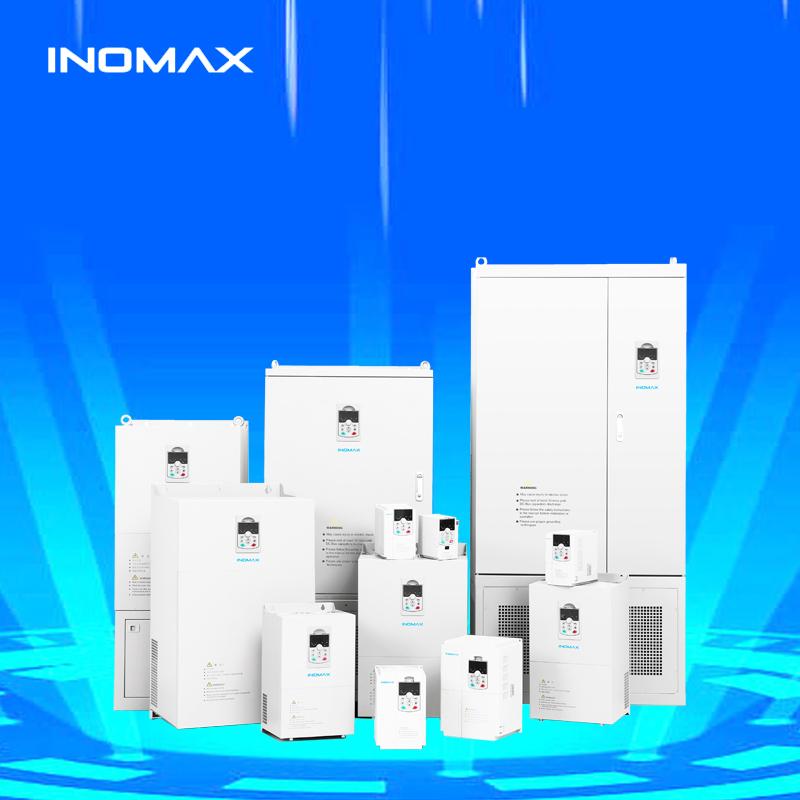
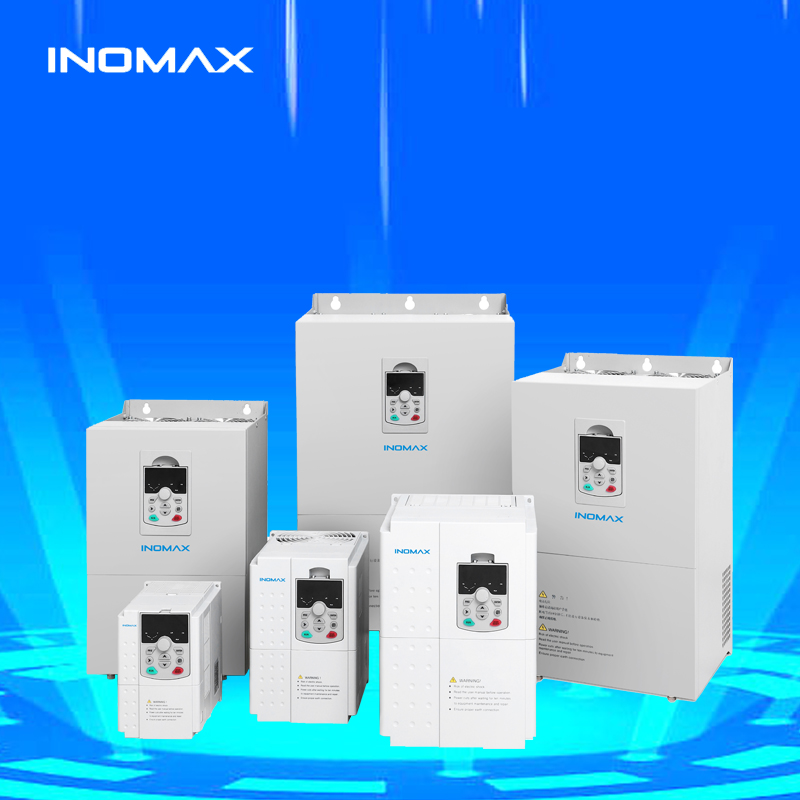
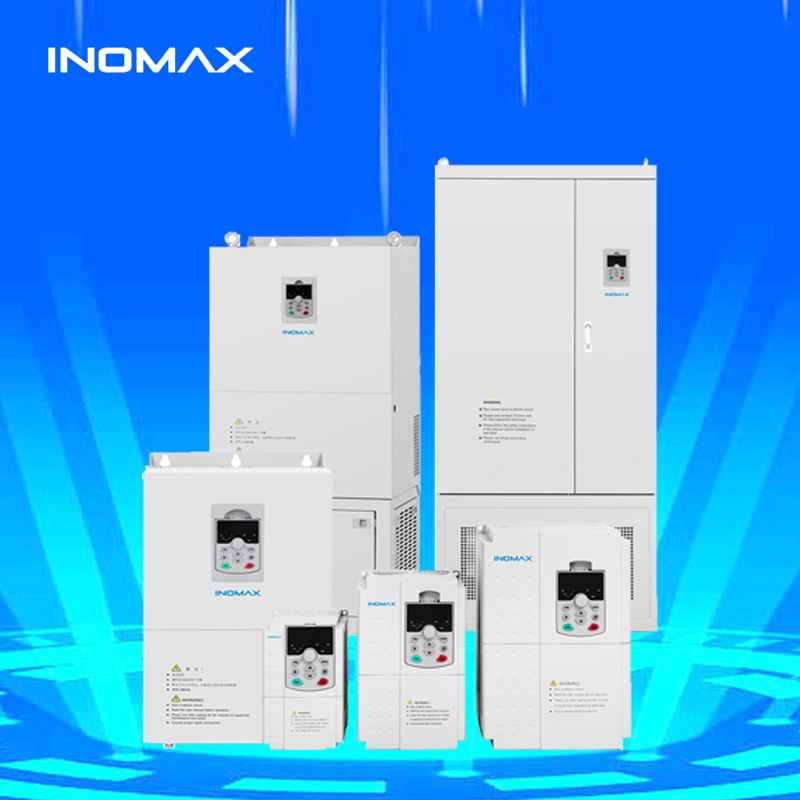
INOMAX MAX600 Series HVAC Drives
High-Performance Variable Frequency Drives for Building Automation, Pumps, Fans, and Compressors
Overview
Heating, ventilation, and air conditioning (HVAC) systems are the lungs of any building—from commercial offices and hospitals to data centers, hotels, airports, and industrial facilities. The challenge is that HVAC systems rarely operate at full design capacity. Cooling loads fluctuate with seasonal changes, occupancy varies throughout the day, and energy costs continue to rise. The solution? Variable frequency drives (VFDs) that adjust motor speed to match actual demand—delivering energy savings of 30–50% or more while maintaining precise comfort control–.
At Inomax Technology, our MAX600 series is specifically engineered for HVAC applications. Built on the same advanced motor control platform as our MAX500 series, the MAX600 adds HVAC‑dedicated features: multi‑pump cascade control, automatic sleep/wake‑up, pipe burst detection, frost protection, fire override mode, and native BACnet MS/TP and BACnet IP communication for seamless building automation system (BAS) integration.
Whether you are designing a new building management system, retrofitting an aging chiller plant, or optimizing fan arrays in a data center, the MAX600 delivers the reliability, efficiency, and intelligence your HVAC system demands—at a significantly lower total cost of ownership than ABB, Danfoss, Schneider Electric, or Invertek alternatives.
Why HVAC Needs VFDs – The Energy Savings Opportunity
Traditional HVAC systems use throttling valves, inlet guide vanes, dampers, or on‑off cycling to control flow. These methods waste enormous amounts of energy. By contrast, VFDs follow the affinity laws:
| Parameter | Fixed Speed (100%) | 80% Speed | 50% Speed |
|---|---|---|---|
| Flow | 100% | 80% | 50% |
| Pressure | 100% | 64% | 25% |
| Power consumption | 100% | 51% | 12.5% |
Typical energy savings with MAX600:
-
Fans: 30–50% energy reduction compared to damper control
-
Centrifugal pumps: 40–60% energy reduction compared to throttling valves
-
Chillers and compressors: 15–30% energy reduction with optimized staging
Beyond energy savings, MAX600 VFDs deliver soft starting (eliminating water hammer and mechanical stress), reduced noise levels, extended equipment life, and compliance with green building standards such as LEED and BREEAM.
MAX600 Series – Key Technical Specifications
| Parameter | Specification |
|---|---|
| Power range | 0.75 kW – 630 kW (1 HP – 850 HP) |
| Voltage range | 3‑phase 380–480 VAC (±10%), 50/60 Hz |
| Output frequency | 0 – 400 Hz |
| Control method | Sensorless vector control (SVC) + V/F control |
| Motor types | Asynchronous (IM), permanent magnet synchronous (PMSM) |
| Starting torque | 150% at 0.5 Hz (SVC) |
| Overload capacity | 120% for 60s (P‑type / variable torque), 150% for 60s (G‑type / constant torque) |
| Carrier frequency | 1.2 – 15 kHz (auto‑adjustable) |
| Enclosure | IP20 standard; IP55 / NEMA 12 optional for outdoor or washdown installations |
| Ambient temperature | -10°C to +50°C (derate above 40°C) |
| Altitude | 1,000 m without derating; up to 3,000 m with derating |
| Certifications | CE, UL, cUL, CSA, RoHS |
| EMC filter | Built‑in C3 filter (standard on all sizes) |
Core HVAC Features – What Makes MAX600 Different
1. Multi‑Pump Cascade Control (1 VFD + Up to 4 Motors)
In many HVAC applications—chilled water circulation, condenser water pumping, booster stations—a single VFD can control up to 4 pumps in a cascade system【MAX600 manual, Appendix 3.1†L114-L120】. The MAX600 automatically starts, stops, and sequences fixed‑speed (across‑the‑line) auxiliary pumps as demand changes, while the lead pump runs under variable speed control.
How it works:
-
Add pump: When the VFD output frequency exceeds the
Add pump frequency(H94.20) and the PID feedback is below setpoint minus pressure tolerance (H94.19) for longer than the add delay (H94.21), an auxiliary pump is started. -
Reduce pump: When the VFD output frequency falls below the
Reduce pump frequency(H94.25) and the PID feedback is above setpoint minus pressure tolerance (H94.24) for longer than the reduce delay (H94.26), an auxiliary pump is stopped.
Key parameters (MAX600 H94 group):
| Parameter | Description | Typical setting |
|---|---|---|
| H94.10 | Variable frequency motor operation | 0 = Fixed VFD, 1 = Cyclic VFD |
| H94.11 | Total number of motors | 1–8 |
| H94.19 | Pressure tolerance for adding pump | 5.0% |
| H94.20 | Running frequency for adding pump | 50.00 Hz |
| H94.21 | Add pump delay time | 10.0 s |
| H94.24 | Pressure tolerance for reducing pump | 4.0% |
| H94.25 | Running frequency for reducing pump | 5.00 Hz |
| H94.26 | Reduce pump delay time | 10.0 s |
This eliminates the need for an external PLC for pump sequencing—saving hardware cost and simplifying commissioning.
2. Automatic Sleep & Wake‑Up Function
During periods of low demand (e.g., nighttime in an office building), running pumps or fans at minimum speed wastes energy. The MAX600 automatically enters sleep mode when demand drops below a threshold and wakes up when demand returns.
Sleep mode triggers:
-
Frequency‑based sleep (H94.01=1): When running frequency ≤ sleep start frequency (H94.02) for longer than sleep delay (H94.04)
-
Deviation‑based sleep (H94.01=2): When PID feedback exceeds setpoint by more than sleep start deviation (H94.03) for longer than sleep delay (H94.04)
Wake‑up triggers:
-
When PID feedback falls below setpoint by more than wake‑up deviation (H94.08) for longer than wake‑up delay (H94.09)
Sleep mode can reduce pump and fan energy consumption by 15–30% during low‑demand periods, with no operator intervention required.
3. Pipe Burst Detection
A ruptured pipe in a water circulation system can cause catastrophic damage before anyone notices. The MAX600 continuously monitors system behavior and can automatically shut down when a pipe burst is detected.
How it works: If the VFD output frequency rises to the upper limit frequency and the PID feedback cannot reach setpoint (indicating pressure cannot be maintained despite maximum pump speed), and this condition persists longer than the pipe burst detection time (H96.02), the drive triggers a fault and stops.
| Parameter | Description | Setting |
|---|---|---|
| H96.00 | Pipe burst action selection | 0 = Normal, 1 = Shutdown |
| H96.01 | Pipe burst detection level | 10.0% (adjustable) |
| H96.02 | Pipe burst detection time | 120.0 s |
4. Frost Protection
In cold climates, water in pipes can freeze during system idle periods, causing burst pipes and costly repairs. The MAX600 includes a built‑in frost protection function that automatically runs pumps at low speed when ambient temperature falls below a set threshold.
The drive supports PT100, PT1000, and KTY84 temperature sensors connected via the analog input. When the measured temperature falls below the frost protection threshold (H96.12), the drive operates at the frost protection frequency (H96.14) to keep water circulating and prevent freezing.
| Parameter | Description | Setting |
|---|---|---|
| H96.10 | Frost protection enable | 0 = Disable, 1 = Enable |
| H96.11 | Temperature sensor type | 0 = None, 1 = PT100, 2 = PT1000, 3 = KTY84 |
| H96.12 | Frost protection threshold | -5.0°C (adjustable -20 to +20°C) |
| H96.14 | Frost protection frequency | 40.0 Hz |
5. Fire Override Mode (Emergency Smoke Evacuation)
In the event of a fire, building codes require HVAC fans to continue operating for smoke extraction—even if the drive would normally trip on overcurrent, overvoltage, or other faults. The MAX600 includes a dedicated fire mode that overrides normal protection functions.
Fire mode options (H93.00):
-
Fire mode 1: The drive continues running at the fire mode frequency (H93.01) regardless of most faults, stopping only if physically damaged.
-
Fire mode 2: The drive runs at the fire mode frequency and continues operating through all faults except output phase loss and output short circuit.
When fire mode is active, the drive records the activation date and time (H93.04, H93.05) for audit purposes. This feature is essential for compliance with international building safety codes (NFPA, IBC, EN 12101).
| Parameter | Description |
|---|---|
| H93.00 | Fire mode selection (0 = Off, 1 = Mode 1, 2 = Mode 2) |
| H93.01 | Running frequency in fire mode (0–50.00 Hz) |
| H93.02 | Motor running direction in fire mode |
6. Water Pipe Soft‑Fill Function
When filling an empty pipe system (e.g., after maintenance or initial startup), rapid filling can cause water hammer—pressure surges that damage pipes, valves, and pumps. The MAX600’s soft‑fill function gradually ramps up pump speed to fill pipes slowly and smoothly.
The drive exits soft‑fill mode and transfers control to the PID controller when either condition is met:
-
The drive runs at the soft‑fill frequency (H96.04) for the full soft‑fill duration (H96.05)
-
The PID feedback value reaches the soft‑fill cutoff level (H96.06)
| Parameter | Description | Setting |
|---|---|---|
| H96.03 | Soft‑fill enable | 0 = Disable, 1 = Enable |
| H96.04 | Soft‑fill frequency | 30.00 Hz |
| H96.05 | Soft‑fill duration | 10.0 s |
| H96.06 | Soft‑fill cutoff level | 30.0% |
7. Pump Cleaning Function
Pumps that sit idle for extended periods can develop scale, sediment buildup, or seized impellers. The MAX600 includes an automatic pump cleaning cycle that runs the motor forward and reverse to dislodge debris and keep the pump in operational condition.
The cleaning cycle can be triggered via a digital input (X terminal function 86). When activated, the drive runs the motor forward at the cleaning frequency for a set duration, pauses, runs reverse, pauses, and repeats for the programmed number of cycles.
| Parameter | Description |
|---|---|
| H96.20 | Forward run frequency for pump cleaning (50 Hz) |
| H96.21 | Reverse run frequency for pump cleaning (30 Hz) |
| H96.24 | Forward run duration (5.0 s) |
| H96.25 | Reverse run duration (5.0 s) |
| H96.27 | Number of cleaning cycles (1–1000) |
8. Condensation Protection
Motors in humid environments can suffer from internal condensation during idle periods, leading to insulation failure. The MAX600 can inject a DC current into the motor during downtime, raising the winding temperature above the dew point and preventing condensation.
When an external condensation sensor triggers the dedicated digital input (X terminal function 91), the drive outputs DC current at the level set by H96.15 for 40 seconds, then stops automatically.
Building Automation System (BAS) Integration
Modern HVAC systems must communicate seamlessly with building management systems (BMS/BAS). The MAX600 supports multiple open protocols for easy integration:
| Protocol | Availability | Application |
|---|---|---|
| Modbus RTU (RS‑485) | Standard | Universal BAS integration, SCADA systems |
| Modbus TCP | Optional | Ethernet‑based building networks |
| BACnet MS/TP | Optional (expansion card) | HVAC‑specific building automation |
| BACnet IP | Optional (expansion card) | Enterprise‑level BMS integration |
| Profinet | Optional | Industrial environments |
| EtherNet/IP | Optional | Rockwell‑based automation |
| EtherCAT | Optional | High‑speed real‑time control |
| CANopen | Standard | Industrial fieldbus |
BACnet integration benefits:
-
The drive can act as a BACnet node on the building automation network
-
Real‑time data sharing (speed, current, power, temperature, pressure, flow)
-
Remote monitoring and control from the BMS workstation
-
Alarm and event reporting directly to the building management system
Dedicated PID Control for HVAC
The MAX600 includes two independent process PID controllers (PID1 and PID2) specifically configured for HVAC applications. PID1 is used for primary closed‑loop control (e.g., maintaining constant duct static pressure, differential pressure, or water temperature). PID2 can be used for secondary loops or as an analog output to external actuators.
PID1 key parameters (H90 group):
| Parameter | Description | Example (static pressure control) |
|---|---|---|
| H90.00 | Unit selection | kPa |
| H90.01 | Number of decimal places | 1 |
| H90.02 | PID1 maximum setpoint value | 2.0 kPa |
| H90.06 | PID1 reference source | Keypad (H90.07) |
| H90.07 | PID1 setpoint | 0.800 kPa |
| H90.08 | PID1 feedback source | AI1 (0–10V pressure transmitter) |
| H90.27 | Proportional gain (Kp) | 1.000 |
| H90.28 | Integral time (Ti) | 5.000 s |
The PID controller supports both positive action (increase speed when feedback is low—typical for supply fans) and negative action (decrease speed when feedback is low—typical for return fans).
Energy Savings Features
Energy Optimizer Mode
The MAX600 includes a built‑in energy optimizer that continuously adjusts output voltage to minimize motor losses. For fan and pump loads with variable torque characteristics, this typically saves an additional 5–15% beyond the base savings from speed reduction.
Automatic Sleep During Low Demand
As described above, the drive automatically enters sleep mode during periods of zero or minimal demand—eliminating unnecessary pump or fan operation and the associated energy consumption.
High Efficiency (>98%)
MAX600 drives achieve overall efficiency exceeding 98% at rated load, minimizing heat dissipation in electrical rooms and reducing cooling requirements for the drive itself.
Power Factor Improvement
VFDs inherently improve motor power factor from 0.7–0.8 (typical for across‑the‑line starting) to >0.95, reducing utility penalties and improving overall electrical system efficiency.
Application Examples
1. Chilled Water Pump Control (Primary‑Secondary Loops)
Application: Primary pumps circulate chilled water through chillers; secondary pumps distribute water to air handling units (AHUs).
MAX600 configuration:
-
PID1 maintains constant differential pressure in the secondary loop using a pressure transmitter at the most remote AHU
-
Multi‑pump cascade control starts/stops secondary pumps as demand changes
-
Sleep mode reduces pump speed to minimum during low load periods (night, weekends)
-
Frost protection prevents freezing in outdoor pump houses
Expected energy savings: 40–60% compared to constant‑speed pumps with balancing valves.
2. Variable Air Volume (VAV) Fan Control
Application: Supply and return fans in a VAV system maintain constant duct static pressure while VAV boxes modulate to control zone temperatures.
MAX600 configuration:
-
PID1 maintains constant duct static pressure using a pressure transmitter located 2/3 down the main duct
-
Fire override mode configured for smoke extraction (fire mode 2, 50 Hz operation)
-
Auto‑restart after power failure with speed tracking
-
Built‑in BACnet communication to BMS for remote monitoring
Expected energy savings: 30–50% compared to inlet guide vanes or discharge dampers.
3. Condenser Water Pump Control with Cooling Towers
Application: Condenser water pumps circulate water between chillers and cooling towers; tower fans modulate to maintain condenser water temperature.
MAX600 configuration:
-
PID1 maintains constant condenser water return temperature (setpoint 29°C)
-
Multi‑pump cascade control sequences multiple pumps in parallel
-
Sleep mode shuts down pumps when chillers are off (night setback)
-
Pipe burst detection protects against ruptured condenser water lines
Expected energy savings: 35–55% compared to constant‑speed operation.
4. AHU Supply/Return Fan Optimization
Application: AHUs with both supply and return fans must maintain building pressurization while controlling supply air temperature.
MAX600 configuration:
-
Two drives (one for supply fan, one for return fan) with master‑follower communication
-
Supply fan controls duct static pressure
-
Return fan tracks supply fan speed with an offset (e.g., return speed = supply speed × 0.95)
-
Fire override mode configures both fans for smoke extraction during emergencies
Expected energy savings: 40–60% compared to constant‑volume AHU operation.
5. Boiler Feed Pump Control
Application: Boiler feed pumps maintain constant water level in steam boilers.
MAX600 configuration:
-
PID1 maintains boiler drum level using a level transmitter (4–20mA)
-
Low water cutoff protection via digital input
-
Sleep mode stops pump when boiler is not firing
-
Soft‑fill prevents thermal shock during boiler startup
Expected energy savings: 20–30% pump energy reduction plus improved boiler efficiency from stable level control.
Technical Comparison – MAX600 vs. Competitors
| Feature | INOMAX MAX600 | ABB ACH580 | Danfoss VLT FC102 | Invertek Optidrive Eco | Schneider ATV212 |
|---|---|---|---|---|---|
| Power range | 0.75–630 kW | 0.75–500 kW | 1.1–1400 kW | 0.75–250 kW | 0.75–630 kW |
| Control technology | Sensorless vector | Direct Torque Control | Sensorless vector | Eco Vector | Sensorless vector |
| Multi‑pump control | Standard (up to 8 pumps) | Optional (extra cost) | Optional (extra cost) | Yes (Optiflow) | Optional |
| BACnet integration | Optional (expansion card) | Standard (embedded) | Optional (extra card) | No | Standard |
| Fire override mode | Standard | Standard | Optional | No | Optional |
| Pipe burst detection | Standard | No | No | No | No |
| Frost protection | Standard | No | No | No | No |
| Pump cleaning cycle | Standard | No | No | No | No |
| Soft‑fill function | Standard | No | No | No | No |
| Built‑in PLC logic | Standard (free) | Standard (free) | No | No | No |
| Virtual I/O | Standard | Optional (extra cost) | No | No | No |
| Conformal coating | Standard | Standard | Optional | Optional | Optional |
| EMC C3 filter | Standard | Standard | Optional | Optional | Optional |
| Built‑in braking chopper | ≤30 kW standard | ≤30 kW standard | ≤22 kW standard | Optional | ≤75 kW standard |
| Typical price | Lowest | Premium | Premium | Medium | Medium |
Why MAX600 stands out:
-
Pipe burst detection, frost protection, pump cleaning, and soft‑fill are not available on ABB, Danfoss, or Schneider HVAC drives—these are unique to MAX600
-
Multi‑pump cascade control is a standard feature on MAX600 but a paid option on ABB and Danfoss
-
Conformal coating and EMC C3 filter are standard on MAX600 (optional and extra cost on many competitors)
-
Virtual I/O eliminates the need for external wiring for simple logic functions (standard on MAX600, optional on ABB)
Comparison with MAX500 and ACS880
| Feature | MAX500 (General Purpose) | MAX600 (HVAC Dedicated) | ACS880 (High Performance) |
|---|---|---|---|
| Target applications | General industrial, pumps, fans, conveyors | HVAC, building automation, water/wastewater | High‑performance, regenerative, multi‑drive, heavy duty |
| Control technology | Sensorless vector + V/F | Sensorless vector + V/F | Direct Torque Control (DTC) |
| Multi‑pump control | No (basic PID only) | Yes (8 pumps, cascade) | Optional (paid software) |
| Sleep/wake‑up | Basic | HVAC‑optimized (frequency or deviation) | Basic |
| Pipe burst detection | No | Yes | No |
| Frost protection | No | Yes (PT100/PT1000/KTY84) | No |
| Fire override mode | No | Yes (2 modes) | Yes (optional) |
| Pump cleaning cycle | No | Yes | No |
| Soft‑fill | No | Yes | No |
| BACnet | No | Optional | Optional |
| Energy optimizer | Yes | Yes | Yes |
| Conformal coating | Yes | Yes | Yes |
Selection guide:
-
Use MAX600 for building automation, HVAC, water supply, wastewater treatment—any application requiring pump‑specific features, BACnet, or multi‑pump sequencing
-
Use MAX500 for general industrial applications (conveyors, mixers, compressors, machine tools) where HVAC‑specific features are not needed
-
Use ACS880 for high‑performance applications requiring Direct Torque Control, regenerative AFE, electronic cam, flying shear, or high‑speed spindles
Application Case Studies
Case Study 1: Commercial Office Building – Chilled Water System Retrofit
Location: Southeast Asia
Building: 25‑story office tower, 50,000 m²
Application: 4 × 75 kW chilled water pumps (primary‑secondary configuration)
Challenge: Existing constant‑speed pumps with balancing valves wasted significant energy. The building automation system required BACnet integration for remote monitoring. Nighttime and weekend occupancy was low, but pumps ran continuously.
Solution: Installed MAX600 drives on all four pumps. Configured multi‑pump cascade control with fixed VFD operation (H94.10=0, H94.11=4). Set PID1 to maintain 2.5 bar differential pressure. Sleep mode enabled with wake‑up at 0.8 bar.
Results:
-
Pump energy consumption reduced by 58% (validated by 12‑month energy audit)
-
Chiller approach temperature improved by 1.2°C due to stable flow
-
BACnet integration enabled BMS monitoring and remote setpoint adjustment
-
Pipe burst detection added as insurance against system leaks
-
Payback period: 11 months
Case Study 2: Hospital AHU Supply/Return Fan Optimization
Location: North America
Building: 300‑bed hospital, operating rooms requiring 24/7 positive pressure
Application: 4 AHUs with supply fans (37 kW) and return fans (30 kW)
Challenge: Operating rooms required precise pressure control to prevent contamination. Existing VFDs had no BACnet communication, limiting BMS visibility. Fire code required smoke evacuation capability.
Solution: Replaced existing drives with MAX600 units. Configured master‑follower operation: supply fan controlled duct static pressure (PID1), return fan tracked supply fan speed with -5% offset to maintain building positive pressure. Fire override mode configured for smoke extraction (fire mode 2, 50 Hz).
Results:
-
Fan energy consumption reduced by 42% compared to previous VFDs (energy optimizer mode)
-
Operating room pressure maintained within ±0.5 Pa of setpoint
-
BMS now monitors all fan parameters in real time via BACnet
-
Fire override mode validated during annual fire safety inspection
-
Payback period: 14 months
Case Study 3: District Cooling Plant – Condenser Water System
Location: Middle East
Plant: 5,000 RT district cooling plant serving 12 buildings
Application: 6 × 200 kW condenser water pumps, 8 cooling tower cells
Challenge: Extreme ambient temperatures (up to 50°C) required robust drives with conformal coating. Pipe burst detection was critical due to high water pressure (10 bar). Frost protection not required due to climate.
Solution: Installed MAX600 drives in IP55 enclosures for outdoor installation. Multi‑pump cascade control with 6 pumps (fixed VFD operation). Pipe burst detection enabled (H96.00=1, H96.02=120s). PID1 maintained condenser water return temperature at 32°C.
Results:
-
Condenser pump energy consumption reduced by 51%
-
Pipe burst detection triggered twice during commissioning (faulty check valves)—prevented major water damage
-
Drives operating reliably at 52°C ambient with derating
-
IP55 enclosures withstood sandstorms and direct sunlight
-
Payback period: 18 months
Case Study 4: Water Treatment Plant – Booster Pump Station
Location: South America
Plant: Municipal water treatment, 50,000 m³/day capacity
Application: 3 × 110 kW booster pumps (2 duty, 1 standby)
Challenge: Pump station experienced frequent dry‑run events due to inlet pressure fluctuations. Water hammer during pump starts damaged pipes. Existing control system had no pump cycling or maintenance timers.
Solution: Installed MAX600 drives with multi‑pump cascade control (cyclic variable frequency operation, H94.10=1). Dry‑run protection enabled (H96.32=2). Soft‑fill function enabled for smooth pipe filling after maintenance. Pump cleaning cycle configured to run weekly.
Results:
-
Dry‑run protection prevented pump damage during low inlet pressure events
-
Soft‑fill eliminated water hammer during pump starts
-
Pump cleaning cycle extended seal life by estimated 40%
-
Energy savings: 44% compared to constant‑speed operation
-
Payback period: 9 months
Frequently Asked Questions
Q1: What is the difference between MAX500 and MAX600 for HVAC applications?
MAX600 adds HVAC‑specific features not available on MAX500: multi‑pump cascade control (up to 8 pumps), automatic sleep/wake‑up based on frequency or PID deviation, pipe burst detection, frost protection (PT100/PT1000/KTY84), fire override mode, pump cleaning cycles, soft‑fill function, and BACnet communication support. For general industrial applications, MAX500 is more cost‑effective. For building automation, water supply, or wastewater, MAX600 is the better choice.
Q2: Does MAX600 support BACnet communication out of the box?
Modbus RTU and CANopen are standard. BACnet MS/TP and BACnet IP require an optional expansion card. We provide full BACnet object mapping and integration support.
Q3: Can MAX600 control permanent magnet synchronous motors (PMSM) for high‑efficiency HVAC applications?
Yes. MAX600 supports both asynchronous (IM) and permanent magnet synchronous (PMSM) motors. For PMSM, set H02-00=1 and perform motor parameter autotuning (H00-15). PMSM efficiency is typically 5–10% higher than IE3 induction motors, making it ideal for new high‑efficiency HVAC installations.
Q4: How do I set up multi‑pump cascade control?
The MAX600 manual (Appendix 3.1–3.13) provides detailed wiring diagrams and parameter settings. Key steps: (1) Enable HVAC function (H94.00=1), (2) Set variable frequency motor operation mode (H94.10), (3) Set total number of motors (H94.11), (4) Configure relay outputs for pump contactors (H06.04, H26.04, H26.11 set to 57–64), (5) Set contactor closing/opening delays (H94.36, H94.37), (6) Configure add/reduce pump frequencies and delays.
Q5: What is the typical payback period for retrofitting a pump or fan with MAX600?
Based on our case studies, typical payback periods range from 6 to 18 months depending on operating hours, electricity rates, and existing control method. For a 75 kW pump running 8,000 hours/year at $0.12/kWh, energy savings of 45% typically yield annual savings of $32,000–$40,000. For a 37 kW fan running 6,000 hours/year, annual savings of $12,000–$15,000 are typical.
Q6: Can MAX600 be installed outdoors?
Yes. The MAX600 is available in IP55 (NEMA 12) enclosures with rugged metal housing, suitable for outdoor installation, washdown areas, dust, and high humidity. The IP55 version includes sealed cable entries, conformal‑coated circuit boards, and a ventilation system that protects against non‑conductive dust and splash damage.
Q7: How does the fire override mode work?
When a fire alarm signal is received via a digital input (X terminal function 79 configured), the drive enters fire mode. In fire mode 1, the drive runs at the preset fire mode frequency (H93.01) and continues operating regardless of most faults—only stopping if physically damaged. In fire mode 2, the drive continues through all faults except output phase loss and output short circuit. The drive logs the activation date and time for audit purposes. This is essential for smoke extraction during building evacuation.
Q8: What communication protocols are available for BMS integration?
Standard: Modbus RTU (RS‑485), CANopen. Optional plug‑in modules: BACnet MS/TP, BACnet IP, Profinet, EtherNet/IP, EtherCAT, Profibus DP. For BACnet, we provide full object mapping and configuration support.
Q9: Does MAX600 have a built‑in energy meter?
Yes. The drive monitors and displays real‑time power consumption (kW), cumulative energy usage (kWh), and can output analog signals proportional to power for external monitoring.
Q10: What is the warranty period?
Standard 2 years. Extended warranty up to 5 years available for qualified installations. The MAX600 is designed for 20+ years of service life in HVAC applications with proper maintenance.
Q11: How does pipe burst detection work?
The drive monitors the relationship between output frequency and PID feedback. Under normal operation, as frequency increases, pressure should rise. If the output frequency reaches the upper limit frequency (maximum pump speed) but the PID feedback remains below setpoint (indicating pressure cannot be maintained), and this condition persists longer than the pipe burst detection time (H96.02, default 120 seconds), the drive triggers a fault and stops, preventing further water loss and damage.
Q12: Can MAX600 be used for variable air volume (VAV) terminal fan control?
Yes. MAX600 is ideal for VAV terminal fans. Use PID1 with duct static pressure feedback, set PID action to positive (increase speed when pressure is low), and configure the PID parameters for fast response. The built‑in energy optimizer reduces fan energy consumption by 30–50% compared to damper control.
Why Choose INOMAX MAX600 for Your HVAC System?
| Advantage | Benefit |
|---|---|
| HVAC‑dedicated features | Multi‑pump cascade, sleep/wake‑up, pipe burst detection, frost protection, fire override, pump cleaning, soft‑fill—all standard |
| Built‑in BACnet support | Seamless integration with building automation systems via optional BACnet MS/TP or BACnet IP |
| Energy savings up to 60% | Energy optimizer mode + variable speed operation + automatic sleep during low demand |
| Conformal coating standard | Reliable operation in humid, dusty, or chemically harsh environments—no extra cost |
| EMC C3 filter standard | Meets electromagnetic compatibility requirements for commercial buildings—no extra cost |
| Wide power range | 0.75 kW to 630 kW—one family for small fans to large chillers |
| IP55 outdoor option | Install directly in pump houses, on rooftops, or in washdown areas without additional enclosures |
| Cost‑effective | Typically 20–40% lower than ABB, Danfoss, or Schneider equivalents |
| Proven reliability | <1% failure rate, 2‑year warranty, 20+ year design life |
| Global support | Direct factory engineering support and worldwide distribution |
Ready to Optimize Your HVAC System?
Whether you are retrofitting an existing chiller plant, designing a new building management system, or upgrading fan arrays in a data center, the INOMAX MAX600 series delivers the features, reliability, and energy savings you need—at a price that makes sense.
Contact us today for:
-
Free HVAC energy savings assessment based on your system parameters
-
BACnet integration support and object mapping
-
Multi‑pump cascade control configuration assistance
-
Retrofit proposal for replacing ABB, Danfoss, Schneider, or Invertek drives
-
IP55 outdoor unit quotation