
Geothermal & District Heating Solutions
High-Performance VFDs for Geothermal Energy and District Heating Applications
Overview
Geothermal energy is one of the most reliable and sustainable sources of renewable power and heating. Unlike solar and wind, geothermal provides baseload capacity — continuous, predictable energy available 24/7, regardless of weather conditions. The global geothermal power equipment market has grown from $29.67 billion in 2025 to an anticipated $31.43 billion in 2026, with a CAGR of 5.9%, driven by increased exploration activities, renewable electricity demand, and government incentives for clean energy The geothermal heating and cooling systems market is expanding even faster, projected to grow from $6.6 billion in 2026 to $11.6 billion by 2032 at a CAGR of 9.70%.
At Inomax Technology, we provide dedicated variable frequency drives (VFDs) engineered for geothermal power generation, geothermal heating systems, and district heating applications. Our VFDs are designed to handle the unique demands of geothermal environments: high temperatures, corrosive fluids, variable load conditions, and long cable runs to downhole equipment.
Whether you are developing a new geothermal power plant, upgrading an existing district heating network, or installing geothermal heat pumps for commercial buildings, our engineering team delivers reliable, energy-efficient VFD solutions tailored to your requirements.
Why VFDs for Geothermal and District Heating?
Variable frequency drives are essential components in geothermal and district heating systems for several critical reasons:
| Benefit | Impact |
| Energy savings | VFDs reduce pumping energy consumption by 36%–88% compared to constant-speed operation, with many sites achieving over 70% savings |
| Reduced plant utility power | Cooling tower fans and hot well pumps — the largest utility loads in geothermal plants — can be optimized through VFD installation, increasing overall plant efficiency |
| Seasonal demand adaptation | Geothermal heating projects experience significant seasonal heat demand fluctuations; VFDs enable pumps to operate efficiently across a broad production range |
| Improved equipment life | Soft starting reduces mechanical stress on pumps, motors, and piping systems |
| Precise temperature control | VFDs modulate flow rates to maintain stable outlet temperatures for district heating networks |
| Grid code compliance | AFE technology delivers <5% THDi, meeting IEEE 519 and utility requirements |
Key Applications
1. Geothermal Power Plants
Geothermal power plants extract heat from underground reservoirs to generate electricity. VFDs play a crucial role in optimizing auxiliary systems that consume significant utility power.
Cooling Tower Fans (CTF)
Cooling towers are essential for condensing geothermal steam after it passes through turbines. In the Sibayak Geothermal Power Plant case study, cooling tower fans represented the largest utility load in the facility. Installing VFDs on cooling tower fans allowed operators to modulate fan speed based on wet bulb temperature fluctuations, reducing energy consumption while maintaining optimal condenser pressure
Hot Well Pumps (HWP)
Hot well pumps recirculate condensed water back into the geothermal reservoir or cooling system. VFD installation on hot well pumps has been shown to achieve energy savings, with modeling validated by actual operational data
Non-Condensable Gas (NCG) Extraction
Geothermal fluids contain non-condensable gases that affect plant performance. VFD-controlled extraction systems optimize gas removal based on real-time conditions, improving overall thermal efficiency.
2. Geothermal Well Pumps (Production & Injection)
Direct-use geothermal systems require pumps to lift hot water from underground aquifers to the surface for heating applications.
Electric Submersible Pumps (ESPs)
Deep geothermal wells (often 800m+) demand robust pumping solutions. In a Dutch geothermal project, a nearly 1,000 HP electric submersible pump delivers approximately 300 cubic meters per hour of 90°C geothermal water from an 800m depth. A 900 kVA VFD reliably generates any voltage, amperage, and frequency required to operate the pump across a broad production range — particularly important for geothermal heating projects where heat demand fluctuates seasonally
Variable Flow for Demand Response
At the Torbett-Hutchings-Smith Memorial Hospital in Marlin, Texas, a VFD modulates submersible production pump speed in response to variations in space and domestic hot water heating demand, delivering reduced pumping energy costs, improved pump and motor life, and better line-to-shaft operating efficiency
3. Geothermal Heat Pump Systems (GHP)
Geothermal heat pumps provide highly efficient heating and cooling for residential and commercial buildings by exchanging heat with the ground.
Ground Loop Circulation
Variable-speed pumping is critical for optimizing geothermal heat pump performance. At the Historic Green Village in Florida’s Anna Maria Island, a Yaskawa VFD adjusts pump speed by controlling the frequency of electrical power supplied to the motor, providing only the supply needed to keep the system operating properly. During lower demand periods, when the VFD runs at 80% of capacity, it provides about 50% energy savings while eliminating the need for a magnetic starter
Compressor Control
Mid-deep geothermal heat pump systems have been extensively studied for load adaptability. Variable-frequency screw heat pumps demonstrate superior performance compared to fixed-frequency alternatives, which cannot adapt to wide variations in compression ratio and load rate. Proper VFD control strategies are essential to avoid frequent on-off cycling that reduces coefficient of performance (COP)
Circulator Pumps
In a Texas residential geothermal installation, upgrading to variable-speed circulators delivered twice the pumping capacity at a one-third reduction in energy consumption compared to original fixed-speed pumps. Overall system energy consumption was reduced by nearly 50%. Fixed-speed pumping typically constitutes 17% of geothermal system energy use; variable-speed circulators reduce that by 50% while lowering the amount of heat injected into the system through over-pumping
4. District Heating Networks
District heating systems distribute hot water from central plants to multiple buildings. VFDs enable precise flow control based on real-time demand.
Heat Pump-Based District Heating
Copenhagen’s Nordhavn district heating plant — a demonstration project supplying three cruise ship terminals and a UNICEF warehouse — uses a groundwater-based heat pump that retrieves 10.5°C saline water from a 150m deep well. The system sends approximately 70–80°C water into the district network, with approximately 40°C water returned for reheating. Variable speed drives regulate the facility’s heating capacity according to flexible demand, ensuring optimal energy use while supporting Copenhagen’s goal of becoming a CO₂-neutral city by 2025
Boiler Plant Efficiency
Research has demonstrated that VFD installation in heating boiler plants significantly reduces specific electrical energy consumption for heat supply. Three different regulation methods — standard variable temperature control with VFD, constant temperature/variable flow control, and extended temperature chart using VFD — all deliver measurable efficiency improvements
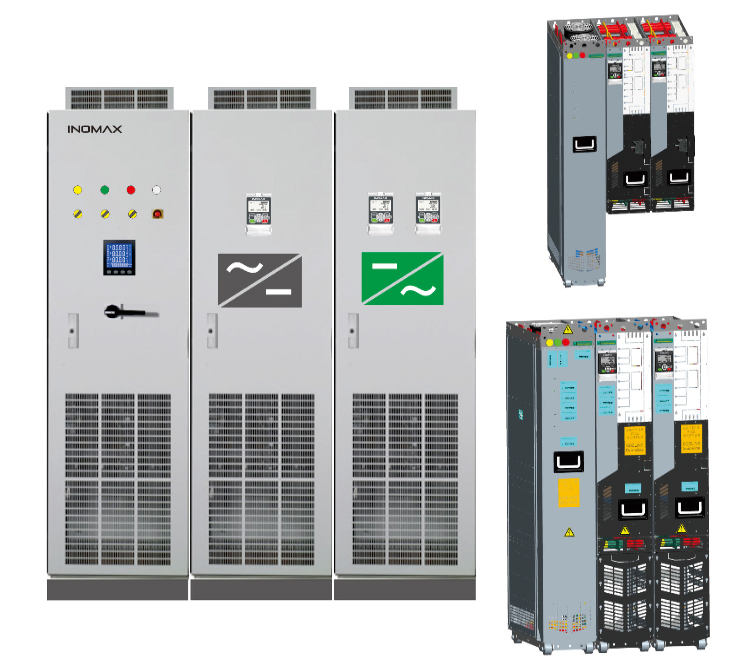
Industry Challenges & Our Solutions
Challenge 1: Long Cable Runs
Geothermal wells often require VFDs located at the surface, with cables extending hundreds of meters downhole. Long cables create capacitive effects that can cause voltage reflection, resonance problems, torque fluctuations, and insulation stress
Our Solution
Our VFDs feature integrated output filters (dV/dt and sine wave filters) specifically designed for long cable applications. We offer:
-
Output choke options to limit voltage rise time
-
Sine wave filters for motor protection in cable runs exceeding 100 meters
-
Resonance analysis and C-type filter recommendations to suppress harmonic amplification
Challenge 2: Harsh Environmental Conditions
Geothermal environments expose equipment to high temperatures, humidity, corrosive gases (H₂S, CO₂), and mineral-rich fluids.
Our Solution
-
Conformal-coated circuit boards for corrosion resistance
-
IP54/IP66 enclosure options for protection against moisture and dust
-
Extended operating temperature range (-20°C to +50°C without derating)
-
Stainless steel hardware for critical components
Challenge 3: Variable Load Profiles
Geothermal heating demand fluctuates daily and seasonally. District heating networks also experience significant load variations.
Our Solution
-
Wide output frequency range (0–500 Hz standard, up to 2,000 Hz optional)
-
PID control with auto-tuning for stable pressure, flow, or temperature regulation
-
Multiple pump control (lead-lag) for distributed pumping stations
-
Energy optimization algorithms that automatically adjust VFD operation for minimum energy consumption at partial load
Challenge 4: Grid Power Quality
Geothermal plants and district heating facilities must comply with strict utility power quality standards.
Our Solution
-
Active front-end (AFE) technology with <5% total harmonic distortion (THDi)
-
Unity power factor operation reduces utility charges
-
Regenerative braking capability for energy recovery
-
Compliance with IEEE 519, IEC 61000, and regional grid codes
Challenge 5: Remote Monitoring & Control
Many geothermal installations are located in remote areas with limited onsite technical support.
Our Solution
-
Built-in Modbus RTU, Modbus TCP, Profibus, Profinet, and EtherNet/IP
-
Web server interface for remote monitoring and diagnostics
-
Data logging for predictive maintenance
-
SCADA integration ready
Key Technical Features
| Feature | Description |
| Long Cable Capability | Integrated dV/dt filters, sine wave filters available for cable runs >100m |
| Harsh Environment Protection | Conformal coating, IP54/IP66 enclosures, -20°C to +50°C operation |
| Active Front End (AFE) | Bidirectional power flow, <5% THDi, unity power factor |
| PID Control | Auto-tuning for stable pressure, flow, or temperature regulation |
| Multi-Pump Control | Lead-lag, cascade, and pump cycling functions for distributed systems |
| Communication Protocols | Modbus, Profibus, Profinet, EtherNet/IP, BACnet for building automation |
| Protection Features | Overvoltage, overcurrent, short-circuit, ground fault, phase loss, and overtemperature protection |
| Energy Optimization | Automatic energy-optimizing algorithms for minimum consumption at partial load |
Product Line Overview
| Series | Power Range | Key Features | Ideal For |
| ACS880-AFE | 75 kW – 2 MW | Active front end, regenerative, <5% THDi, output filters for long cables | Geothermal power plants, large district heating pumps |
| MAX500 | 5.5 kW – 500 kW | Built-in PID, multi-pump control, BACnet communication | Geothermal heat pumps, building circulation loops |
| Project related | Custom | Fully customizable voltage (up to 690V), enclosure, control features | Specialized geothermal projects, high-temperature environments |
Why Choose Inomax Technology?
Geothermal & District Heating Expertise
We understand the unique requirements of geothermal applications — from downhole ESPs to district heating distribution networks. Our engineering team has extensive experience in both power generation and thermal distribution systems.
Field-Proven Reliability
Our VFDs are deployed in geothermal power plants, district heating networks, and commercial heat pump systems across multiple continents, with proven performance in demanding 24/7 operation.
Global Support Network
From system design and commissioning to ongoing maintenance, our global support team ensures your geothermal or district heating system operates at peak efficiency.
Energy Efficiency Focus
Geothermal and district heating systems are inherently efficient — but adding VFDs makes them even more so. Our energy-optimizing algorithms typically reduce pumping energy consumption by 40–70% compared to fixed-speed operation.
Case Study: Geothermal Power Plant Auxiliary Optimization
Project Location: Southeast Asia
Plant Capacity: 13.3 MW gross
Application: Utility power reduction for cooling tower fans and hot well pumps
Challenge: The geothermal power plant’s cooling tower fans and hot well pumps represented the largest utility loads, operating at fixed speed regardless of wet bulb temperature or condensate flow requirements. The operator sought to reduce auxiliary power consumption without compromising plant output.
Solution: Inomax Technology supplied VFDs for both cooling tower fan motors and hot well pumps, integrated with the plant’s existing DCS system. The VFDs automatically modulate fan and pump speed based on real-time condenser pressure, wet bulb temperature, and hot well level measurements.
Results:
-
Achieved energy savings validated by actual operational data
-
Cooling tower fan energy consumption reduced by modulating speed in response to wet bulb temperature fluctuations (15°C–25°C range)
-
Hot well pump energy consumption optimized through VFD control
-
Improved condenser pressure stability
-
Reduced mechanical wear on fans and pumps
-
Simple payback achieved within 18 months
Case Study: Commercial Geothermal Heat Pump System
Project Location: Texas, USA
Facility Size: 30,000 sq. ft. private residence
Application: Geothermal heat pumps for radiant floor heating and cooling
Challenge: The original fixed-speed pumping system consumed excessive energy and lacked the flexibility to match varying heating and cooling loads throughout the year.
Solution: Upgraded to variable-speed circulators (MAGNA3 series equivalent functionality) with VFD control, integrated with variable-speed heat pumps to create a fully variable-speed source-side system.
Results:
-
Delivered twice the pumping capacity at one-third the energy consumption of original fixed-speed pumps
-
Reduced overall system energy consumption by nearly 50%
-
Fixed-speed pumping (17% of system energy use) replaced with variable-speed circulation, reducing energy use by 50% while lowering over-pumping heat injection
-
Simplified controls: single closed contact activates ground loop heat exchanger when any heat pump calls
-
Complete system installation completed within 10 days by two technicians
Technical Resources
Download our technical documentation for detailed specifications:
-
Geothermal VFD Selection Guide – Step-by-step sizing for well pumps, circulation pumps, and cooling tower fans
-
Long Cable Application Note – Output filter selection and resonance mitigation for downhole ESPs
-
District Heating Control White Paper – PID tuning and multi-pump control strategies
-
IX8000-AFE Series Datasheet – Complete technical specifications for geothermal power plant applications
-
Grid Code Compliance Reference – IEEE 519, IEC 61000 compliance data
Frequently Asked Questions
Q1: How do I size a VFD for a geothermal well pump or downhole electric submersible pump (ESP)?
A: Proper sizing of a VFD for a geothermal well pump (or ESP) requires several key parameters: motor rated power (kW/HP), full load current (FLA), voltage rating (typically 380–690V for surface-fed ESPs), and the required speed range. Unlike surface pumps, ESPs often have long cable runs that introduce voltage drop and capacitive charging current. Rule of thumb: Choose a VFD with output current rating at least 15–20% higher than the motor nameplate FLA to accommodate cable charging effects and thermal derating due to high ambient temperature (often >50°C at wellhead). Additionally, consider the pump’s affinity laws: flow varies linearly with speed, pressure varies as speed squared, and power varies as speed cubed. For geothermal heating systems where heat demand fluctuates seasonally, a VFD sized for 80–120% of nominal flow gives best energy efficiency. Contact our engineering team with your pump curve and well depth – we provide free sizing analysis including cable length compensation and harmonic filter requirements.
Q2: Can your VFDs handle long cable runs for deep geothermal wells (over 500 meters)?
A: Yes. Standard VFDs without output filters may experience voltage reflection (reflected wave) when cable length exceeds 50 meters, potentially damaging motor insulation. For geothermal wells of 500m or deeper, we provide integrated dV/dt filters (up to 150m) or sine wave output filters (up to 2000m). Our sine wave filters reduce voltage rise time to <500V/μs and peak voltage to <1.1× DC bus voltage, protecting downhole ESP motors. We also offer cable resonance analysis – a free engineering service to identify and suppress harmonic amplification that can occur at specific cable lengths. For a recent 800m geothermal project in the Netherlands, we supplied a 900 kVA VFD with custom sine wave filter that successfully drives a 1,000 HP ESP at full speed without motor stress. Please provide your cable type, length, and motor insulation class for a tailored recommendation.
Q3: What energy savings can I expect when adding a VFD to a geothermal heat pump circulation pump?
A: Field studies consistently show 40–70% reduction in pumping energy when converting from fixed-speed to variable-speed circulation in geothermal heat pump (GHP) systems. Fixed-speed pumps typically constitute about 17% of total system energy use. By installing a VFD-controlled circulator, you cut that 17% by at least 50% – meaning overall system energy consumption drops by ~8–10%. In one Texas residential project (30,000 sq. ft.), upgrading to variable-speed circulators delivered twice the pumping capacity at one-third the energy consumption of original fixed-speed pumps. For commercial systems with multiple heat pumps, a single VFD on the main loop with pressure-sensorless control (using built-in PID) can modulate flow based on actual heat demand. We provide a free energy savings calculator – just tell us your pump power, operating hours, and current control method.
Q4: Do I need a special VFD for a district heating boiler pump or circulation pump?
A: District heating applications benefit from VFDs with specific features: PID control (for maintaining differential pressure or return temperature), multi-pump cascading (for lead-lag operation of multiple boiler or distribution pumps), and BACnet communication (for integration with building management systems). Our IX6000-HP series includes all these as standard. For large district networks (e.g., Copenhagen’s Nordhavn plant), we recommend our AFE (Active Front End) VFDs to maintain unity power factor and <5% THDi – important when many VFDs operate simultaneously on the same grid. Also consider automatic energy optimization: our drives continuously adjust voltage to match load, reducing motor core losses at partial flow. Typical payback for a district heating VFD retrofit is 12–24 months based on electrical savings alone, not including reduced mechanical maintenance from soft starts.
Q5: Can I use a standard general-purpose VFD for a geothermal cooling tower fan?
A: Technically yes, but we strongly recommend a VFD with condenser pressure PID and wet-bulb temperature feedforward for optimal results. Geothermal power plants (e.g., Sibayak plant case study) saw significant auxiliary power reduction by modulating cooling tower fan speed based on real-time wet-bulb temperature fluctuations (15–25°C range). A general-purpose VFD lacks these specialized control algorithms. Our IX4000-Pump series includes a cooling tower fan macro that accepts 4–20mA pressure transmitter input and automatically adjusts fan speed to maintain optimal condenser backpressure. Additional features to look for: flying start (to catch a spinning fan after power loss), fire mode override (for emergency full-speed operation), and bearing temperature monitoring (via external thermistor input). For plants in corrosive geothermal atmospheres (H₂S present), specify conformal-coated boards and IP54 enclosure.
Q6: What communication protocols do your geothermal VFDs support for SCADA integration?
A: Our VFDs support a wide range of industrial protocols: Modbus RTU (RS485), Modbus TCP/IP, Profinet, Profibus DP, EtherNet/IP, CANopen, and BACnet MS/TP & IP. For remote geothermal wells where only cellular or satellite connection is available, we offer an optional web server module that provides real-time data (current, speed, power, temperature, fault history) via a standard web browser – no SCADA license required. You can also set up email or SMS alerts for conditions like “pump running below minimum speed” (indicating well drawdown) or “output current exceeds 110% for 10 minutes” (suggesting scaling or wear). For district heating networks with multiple pumping stations, we recommend using Profinet IRT for synchronized control and time-stamped fault logging. All our VFDs come with a free configuration software (Windows-based) for easy parameter upload/download and data logging.
Q7: How does a VFD protect a geothermal pump from dry-run or cavitation damage?
A: Our VFDs include built-in pump protection functions that go beyond standard overcurrent trips:
-
Underload detection: Monitors motor power or current; if the value falls below a settable threshold for a settable time, the drive trips or issues a warning – indicating dry run or loss of prime.
-
Torque limit with delay: For ESPs, a sudden torque drop often signals gas locking or cavitation. The VFD can reduce speed automatically to re-establish NPSH (Net Positive Suction Head) before tripping.
-
Soft-fill and pipe-fill: For vertical turbine pumps, the drive can start at low speed (e.g., 10 Hz) for 30 seconds to slowly fill the discharge pipe, preventing water hammer.
-
Automatic reset with escalating delay: For remote wells, the VFD can attempt up to 5 restarts after a dry-run trip, with increasing wait times (1 min, 5 min, 15 min, 1 hr, 4 hrs) – avoiding nuisance service calls. All protection thresholds are adjustable via the keypad or software.
Q8: Can your VFDs be used for both geothermal heating and cooling (reversible heat pumps)?
A: Absolutely. Geothermal/ground-source heat pumps often operate in both heating and cooling modes, reversing the refrigerant cycle. Our VFDs support bidirectional operation without any hardware change – the direction of motor rotation (for compressor or circulation pump) is controlled by a digital input. Key features for reversible systems:
-
Fast reversing time: Our drives can change direction in <200ms (including DC braking to stop before reversing).
-
Auto-tuning for both directions: One-time auto-tuning captures motor parameters valid for forward and reverse.
-
Energy optimization in partial load: During mild weather, the compressor may only need 30–50% capacity. Our VFD reduces motor voltage and frequency accordingly, maintaining COP (Coefficient of Performance) above 4.0 even at low loads – fixed-speed units would cycle on/off, wasting energy.
-
Night setback mode: You can program a reduced speed schedule (e.g., 40 Hz from 10pm to 6am) for circulation pumps serving offices or schools. For a case study, a Maryland school saved 38% on pumping energy by adding night setback to their ground loop circulator.
Q9: What certifications do your geothermal VFDs carry for international projects?
A: Our standard VFDs are CE (European Conformity) and UKCA marked. For North American projects, we offer UL 508C listed and cUL certified models (suitable for USA and Canada). For hazardous locations near geothermal wells with potential H₂S or methane, we provide ATEX (Zone 2) and IECEx certified VFDs in explosion-proof enclosures (Ex d or Ex e). Additionally, our marine-grade VFDs (often used in offshore geothermal platforms) carry DNV, ABS, BV, LR, and CCS type approval. For specific utility grid codes (e.g., IEEE 519 for harmonic limits, G99 for UK, VDE-AR-N 4110 for Germany), we provide compliance test reports and simulation models (PSCAD/EMTDC) upon request. Always specify your project location and any required certifications when inquiring.
Q10: How do I integrate a VFD with an existing geothermal plant DCS or PLC?
A: Integration is straightforward. Our VFDs offer:
-
Hardwired I/O: 6 digital inputs (start/stop, speed select, fault reset), 2 analog inputs (0–10V or 4–20mA for speed reference), 2 relay outputs (running, fault), and 2 analog outputs (actual speed, current). You can connect directly to a PLC’s discrete and analog cards.
-
Fieldbus communication: For DCS systems, we recommend using Profibus DP (standard) or Profinet (real-time). We provide the complete GSD file (for Profibus) or EDS file (for EtherNet/IP) and a free configuration example for Siemens TIA Portal, Rockwell Studio 5000, or CODESYS.
-
Modbus mapping: All drive parameters are accessible via Modbus RTU/TCP. You can read/write up to 20 registers per message. We supply a detailed register map (holding registers for speed reference, actual values, fault codes) and sample ladder logic for reading/writing.
-
Web server integration: For remote plants without DCS, the built-in web server allows you to monitor and control the VFD from any browser – no software installation needed. Historical trends (last 7 days) can be exported as CSV.
Our engineering team can assist with the initial commissioning and provide a “start-up checklist” specific to your control system.
Q11: What maintenance is required for a VFD in a geothermal environment (high temperature, corrosive gas)?
A: Geothermal environments accelerate wear on certain components. We recommend the following preventive maintenance schedule:
| Interval | Action |
| Monthly | Visual inspection for dust accumulation on heatsink; clean with compressed air (low pressure). Check cooling fan operation (audible). |
| Quarterly | Tighten power terminals (torque to specification – thermal cycling loosens connections). Inspect conformal coating for any damage. |
| Every 6 months | Measure DC bus capacitor ripple voltage (our drives have self-diagnostic – display parameter dC-ripple). If >5% of nominal, schedule replacement. |
| Annually | Replace cooling fans (expected life 40,000 hours ~ 5 years, but in high-temperature environment, reduce to 2-3 years). Test I/O functionality. |
| As needed | If H₂S is present, we offer a gold-plated control terminal option to prevent corrosion. Also, use stainless steel cable glands and enclosure hardware. |
For remote wells, we recommend installing a humidity and temperature sensor inside the VFD enclosure (our VFD has an auxiliary 24V supply and analog input for this). Set an alarm when internal temperature exceeds 55°C or humidity >85% – these conditions dramatically shorten component life. We offer extended warranty and preventive maintenance contracts for geothermal installations.
Q12: Can I use a single VFD to control multiple geothermal circulation pumps in parallel?
A: Yes – this is called multi-pump or cascade control. Our MAX600 series includes a built-in cascade controller that can manage up to 4 pumps with one VFD. How it works:
-
Lead pump (connected to VFD) runs at variable speed to meet demand.
-
When the lead pump reaches maximum speed (e.g., 50 Hz) and demand still not satisfied, the controller automatically starts the first lag pump directly across the line (or via soft starter), then reduces VFD speed to balance flow.
-
When demand drops, the controller stops lag pumps one by one and returns to single VFD operation.
-
Automatic pump rotation equalizes running hours among all pumps (programmable every 24 hours or after 100 starts).
Benefits: Lower initial cost (one VFD instead of four), reduced energy consumption (only one pump runs at variable speed, others either off or fixed), and simplified control (no external PLC needed). For district heating plants with large seasonal load swings, this approach typically saves 30–40% in pumping energy compared to fixed-speed operation. Provide your pump curve and desired flow range, and we can configure the cascade parameters remotely.
Ready to Discuss Your Geothermal or District Heating Project?
Every geothermal and district heating system has unique requirements. Our engineers are ready to help you select, size, and integrate the right VFD solution for your application.
Contact us today to:
-
Request a technical consultation for your geothermal power plant or district heating network
-
Download datasheets and selection guides
-
Discuss your project timeline and specific environmental conditions
-
Schedule a product demonstration
-
Receive a free energy savings estimate